
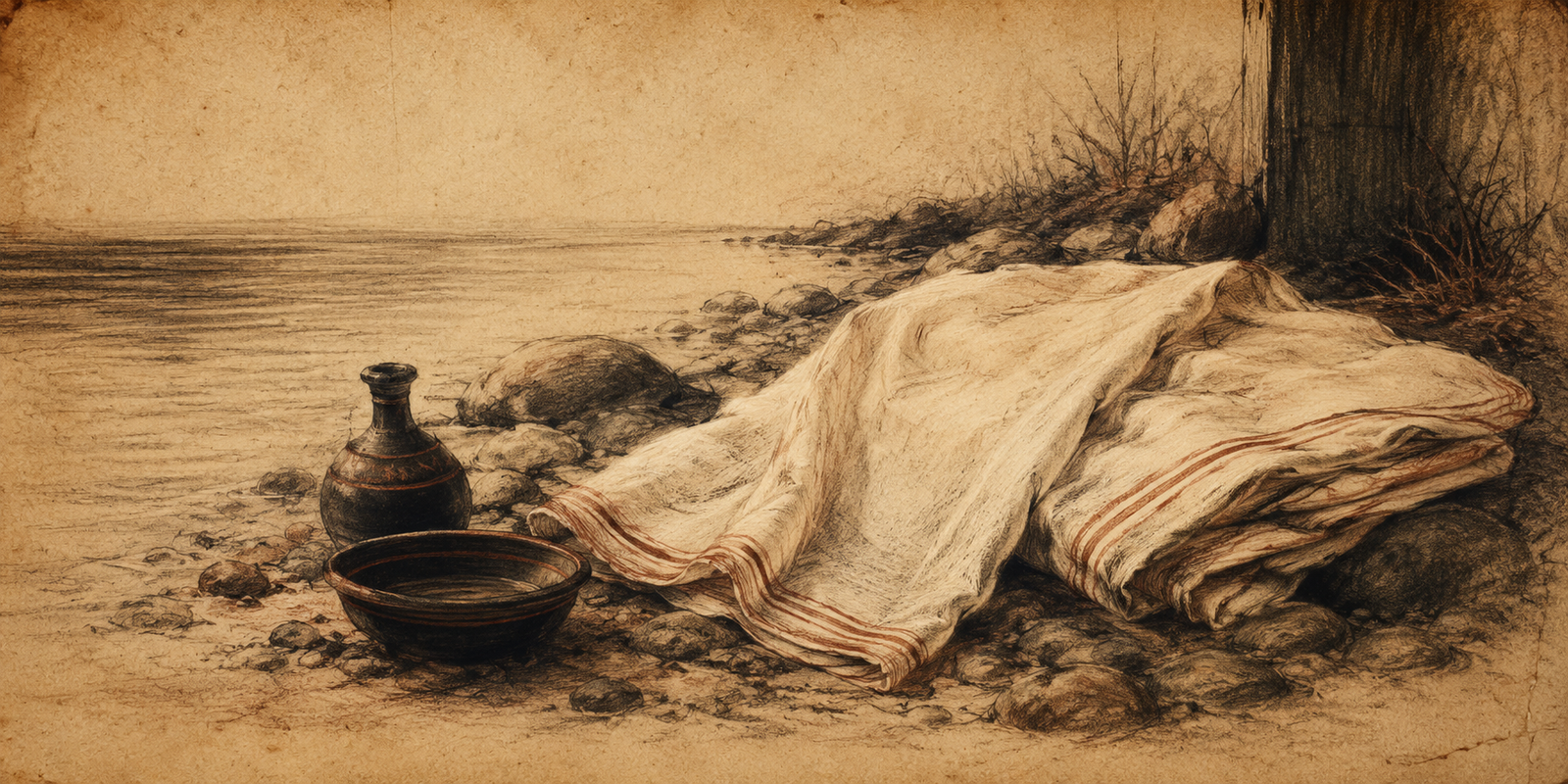

The Stranger, the Girl, and the Law of Mercy
The Stranger, the Girl, and the Law of Mercy is a reader’s guide to The Long Return VI — Nausicaa at the River, part of The Long Return, A. M. Sharp’s ongoing prose retelling of Homer’s Odyssey in The Hospitable Dark.
The episode at the river is often remembered for its tenderness: Nausicaa, the princess, the washing, the ball, the shipwrecked man rising from the leaves. But the scene is more serious than charm. Odysseus appears before he can be safely understood. He has no cloak, no companions, no ship, no visible rank, and no usable name. The sea has stripped him almost to the bare fact of need.
The guide begins there: with a frightening stranger and a young woman who does not let fear complete the judgement.
The first mercy shown to Odysseus after the storm is not grand.
It is not a palace. It is not a feast. It is not a ship pulled down to the water and filled with men willing to row him home. It is not even welcome, not yet.
It is a girl standing still.
That is easily missed, because the river scene has so much brightness around it: the washing, the ball, the garments spread in the sun, the sudden movement from household work into mythic consequence. It is one of the tenderest thresholds in The Odyssey, and tenderness is often misread as softness. A princess finds a shipwrecked man. A young girl sees a stranger. The possibility of romance rises briefly on the surface of the water and then is gone.
But the scene is more serious than charm.
Odysseus comes out of the bushes before he can be safely understood. He has no ship, no companions, no cloak, no visible rank, no proof of origin, and no name he can yet use. The sea has stripped him back almost to the bare fact of need. He is not, in any way useful to those who see him, the king of Ithaca, the husband of Penelope, the father of Telemachus, the man of Troy, or the favourite of Athena.
He is a frightening stranger at the edge of the river.
That is why Nausicaa matters.
Mercy that begins after recognition may still be noble. It may still be costly. But it is not the first law of welcome. The first law begins earlier, before the stranger has become legible, before the house knows whether honour or danger has arrived at its door. It begins when someone sees need before anyone can safely identify merit.
Mercy begins where proof has not yet arrived.
This is one of the deep laws of The Odyssey. Again and again, the poem asks what a house is by asking how it receives the unknown person before it. The stranger may be a beggar, a god, a murderer, a king, a liar, a survivor, a threat, or a test. The house does not yet know. That is the point. Hospitality is not a reward for a completed biography. It is the discipline of behaviour before certainty.
The full reader’s guide continues by tracing Nausicaa’s intelligence, Odysseus’s restraint, Athena’s hidden arrangement, and the practical form mercy takes: clothing, washing, food, privacy, direction, and social protection before the stranger has become knowable.
Continue reading: The Stranger, the Girl, and the Law of Mercy at The Hospitable Dark on Substack.
Also in The Hospitable Dark

The Long Return VII — The Palace of Alcinous
Odysseus reaches the palace of Alcinous, but safety is not yet home. In this seventh instalment of The Long Return, hospitality becomes a moral test: a good house receives the stranger’s body before demanding his story.

When Favour Is Mistaken for Right — On Bellerophon
A companion essay to Bellerophon — The Bridle and the Fall, exploring Pegasus, divine favour, the bridle, heroic ascent, and the danger of mistaking help for permanent right. From The Hospitable Dark, this essay asks why Bellerophon’s tragedy is not false greatness exposed, but real help wrongly remembered.

Bellerophon — The Bridle and the Fall
A literary Greek myth retelling of Bellerophon, Pegasus, and the divine bridle: a tale of heroic ascent, misremembered grace, and the moment a true gift becomes proof in the wrong hands. From The Hospitable Dark, where old stories are retold in a warm, grave voice.
Continue Reading
If this piece found something in you, you may wish to continue the journey elsewhere.
On The Lantern Chronicles, I gather writings from Angkor, myth and legend, contemplative essays, and poetry — works shaped by silence, beauty, wonder, memory, and the deeper questions that follow us through the world.
It is a place for stone and story, reflection and vow, shadow and revelation.
You would be most welcome there.