
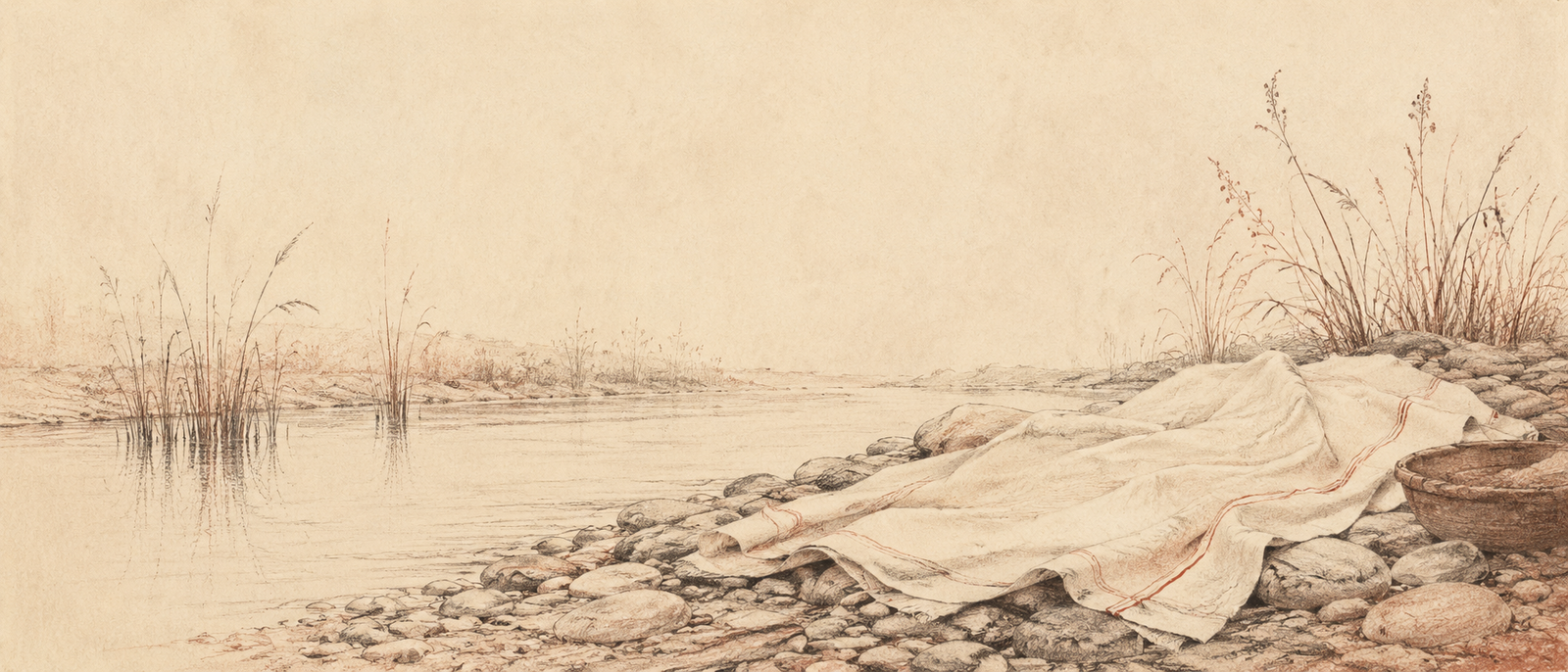

The Long Return VI — Nausicaa at the River
In The Long Return VI — Nausicaa at the River, Homer’s Odyssey moves from storm into mercy.
Odysseus has survived the sea, but survival has not yet restored him to human society. He has no ship, no crew, no cloak, no name he can safely give. What meets him first is not a king, not a warrior, not a court, but a girl at the river with washed cloth spread across stones.
This instalment turns on one of the deepest laws of the Odyssey: hospitality begins before identity is known.
The linen had not yet been washed.
That was the first trouble of the morning, before anyone had spoken of ships, strangers, gods, or the man sleeping under leaves near the river-mouth. In the house of Alcinous, where the floors were clean and the doors well fitted and the servants moved with the practised quiet of people who knew their work, there were still garments folded too long in baskets, cloaks that had taken the smell of cupboards, bright things dulled by use, and marriage-cloth waiting for water.
Nausicaa woke with this knowledge in her.
It had come to her in a dream, though dreams in those days were not always the loose and wandering things they are now. Some came like smoke from a tired mind. Some came from food and weather and the strange little anxieties of the day before. But some entered a sleeping room with a step of their own, and when they left, the air seemed changed.
In the dream, a girl she knew had stood beside her bed. She was one of the daughters of Dymas, near to Nausicaa in age, one of those friends whose speech could enter where a mother’s warning might be refused.
“Nausicaa,” the girl had said, “how can your mother have so careless a daughter? Your bright clothes are lying neglected. Soon enough you will need them. Soon enough your wedding will be spoken of. A bride must have clean garments ready, and those who go with her must be clothed honourably too. Ask your father for the mule-wagon in the morning. Take the maids to the river. Wash what must be washed.”
It was not a command exactly.
It was worse than that.
It was the kind of reminder that makes obedience feel like one’s own idea.
Nausicaa had half risen in sleep, and in the faint light before waking she saw the girl’s face shine more beautifully than any girl’s face had a right to shine. Then the figure was gone, and the house was only a house again: still beams, quiet walls, the breathing of servants nearby, and the morning waiting outside.
Athena, who had worn the friend’s face, went back into the immortal air.
Nausicaa lay still for a moment.
She was young enough for the word marriage to move through her like a bird startled from a tree, and old enough to know that no house remains a child’s house forever.
Continue reading: The Long Return VI — Nausicaa at the River at The Hospitable Dark on Substack.
Also in The Hospitable Dark

The Long Return VII — The Palace of Alcinous
Odysseus reaches the palace of Alcinous, but safety is not yet home. In this seventh instalment of The Long Return, hospitality becomes a moral test: a good house receives the stranger’s body before demanding his story.

When Favour Is Mistaken for Right — On Bellerophon
A companion essay to Bellerophon — The Bridle and the Fall, exploring Pegasus, divine favour, the bridle, heroic ascent, and the danger of mistaking help for permanent right. From The Hospitable Dark, this essay asks why Bellerophon’s tragedy is not false greatness exposed, but real help wrongly remembered.

Bellerophon — The Bridle and the Fall
A literary Greek myth retelling of Bellerophon, Pegasus, and the divine bridle: a tale of heroic ascent, misremembered grace, and the moment a true gift becomes proof in the wrong hands. From The Hospitable Dark, where old stories are retold in a warm, grave voice.
Continue Reading
If this piece found something in you, you may wish to continue the journey elsewhere.
On The Lantern Chronicles, I gather writings from Angkor, myth and legend, contemplative essays, and poetry — works shaped by silence, beauty, wonder, memory, and the deeper questions that follow us through the world.
It is a place for stone and story, reflection and vow, shadow and revelation.
You would be most welcome there.