
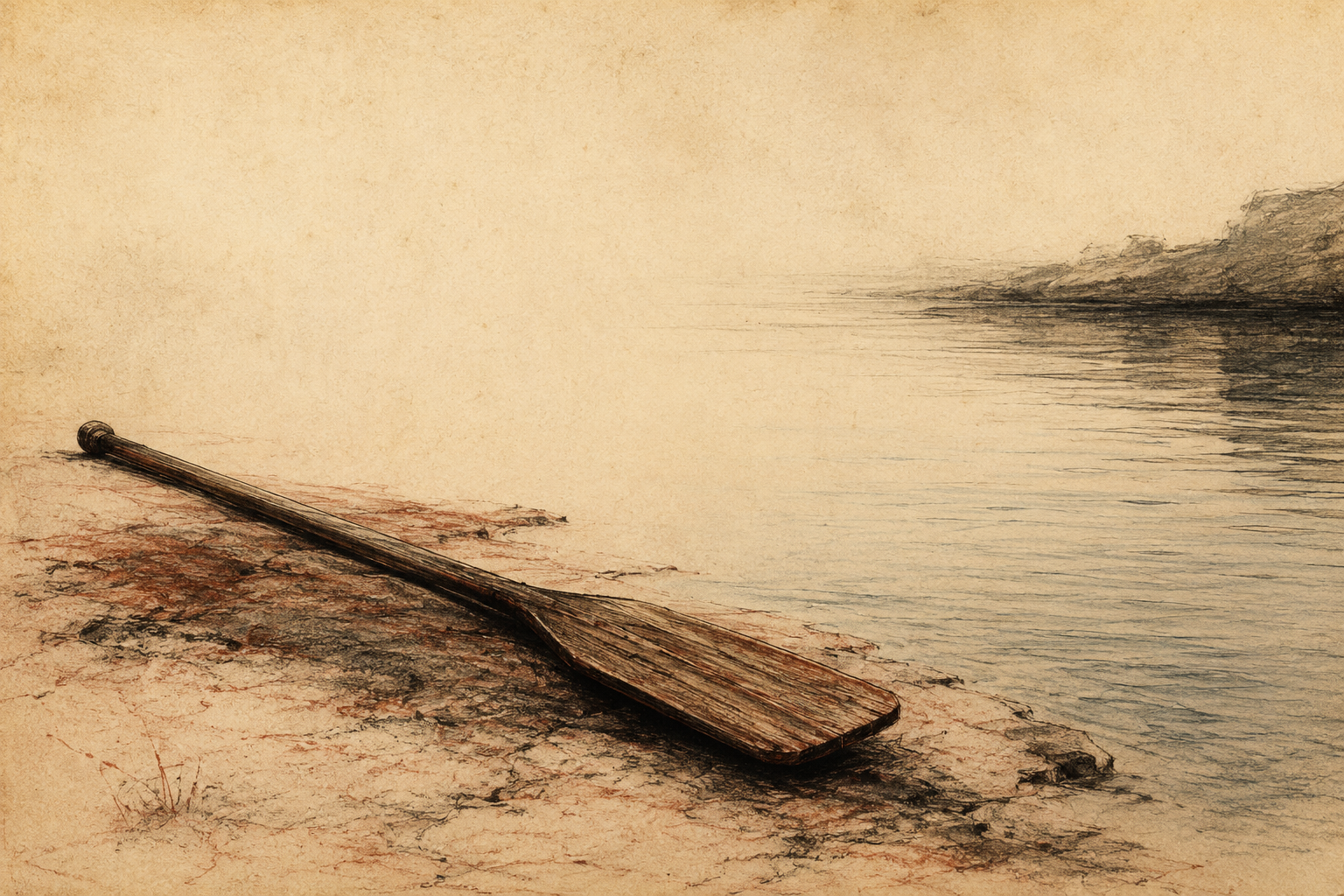

Why Calypso Cannot Be Home
Why Calypso Cannot Be Home is a Reader’s Guide to The Long Return V — From the Goddess to the Storm, the fifth instalment of A. M. Sharp’s prose retelling of Homer’s Odyssey inside The Hospitable Dark.
Calypso’s island is not one of the obvious horrors of the poem. That is what makes it dangerous. Odysseus is not in the Cyclops’ cave. He is not in the suitors’ hall. He is not on the battlefield before Troy. He is sheltered, desired, fed, and offered the one thing no mortal house can offer: immortality.
The question is therefore not simply why Odysseus leaves a prison.
The harder question is why he must leave a paradise.
The first difficulty with Calypso is that her offer is not nothing.
She does not offer Odysseus a cave full of bones. She does not offer him the suitors’ hall, where appetite has learned to call itself entitlement. She does not offer him Troy, with its names burning into songs while the living men who carried them begin to vanish. She offers him shelter, beauty, desire, and an end to danger. She offers him food. She offers him rest. She offers him herself. She offers him immortality.
That is why the episode matters.
If Calypso offered only imprisonment, the moral shape would be simple. Odysseus would be a captive, and his departure would be escape. But Homer gives the scene more pressure than that. Calypso keeps him. She also loves him, or at least wants him with a force that resembles love from a divine distance. She is wounded by his leaving. She is not wrong to think that what she offers is extraordinary.
A goddess offers a man what men have always feared losing: safety from age, safety from death, safety from the sea, safety from the ruin that waits in ordinary time.
And he refuses.
The image Homer gives us is not a man drunk on pleasure. It is a man sitting apart on the shore, looking toward the sea, grieving for a place he may never reach. The island is beautiful. The goddess wants him. The body is sheltered. But the soul has already moved elsewhere.
That is the trouble.
Odysseus does not leave because he has discovered that Calypso’s island is ugly. He leaves because its beauty cannot answer the shape of his longing. He does not refuse immortality because he is immune to temptation. He refuses because immortality, offered here, would require him to step outside the mortal life that still requires him.
Calypso can keep him alive forever.
She cannot bring him home.
Home, in The Odyssey, is not simply the place where the body is protected. If it were, Calypso’s island would be enough. It has shelter. It has beauty. It has food. It has the promise that nothing need happen next unless Odysseus consents to remain inside a life without ending.
But home is not the absence of danger.
Home is the place where a life remains answerable.
That is what Calypso cannot give him. She cannot return him to Penelope’s long intelligence, to Telemachus’s unfinished manhood, to Laertes’s grief, to the servants who have kept faith and those who have not, to the suitors eating through the order of his house. She cannot return him to the bed that will one day test whether anyone still knows what cannot be moved. She cannot return him to the name that has become rumour, wound, inheritance, and threat.
She can remove suffering from his future.
But she can only do this by removing him from the web of obligations that makes his life recognisable as his own.
Continue reading: Why Calypso Cannot Be Home at The Hospitable Dark on Substack.
Also in The Hospitable Dark

The Long Return VII — The Palace of Alcinous
Odysseus reaches the palace of Alcinous, but safety is not yet home. In this seventh instalment of The Long Return, hospitality becomes a moral test: a good house receives the stranger’s body before demanding his story.

When Favour Is Mistaken for Right — On Bellerophon
A companion essay to Bellerophon — The Bridle and the Fall, exploring Pegasus, divine favour, the bridle, heroic ascent, and the danger of mistaking help for permanent right. From The Hospitable Dark, this essay asks why Bellerophon’s tragedy is not false greatness exposed, but real help wrongly remembered.

Bellerophon — The Bridle and the Fall
A literary Greek myth retelling of Bellerophon, Pegasus, and the divine bridle: a tale of heroic ascent, misremembered grace, and the moment a true gift becomes proof in the wrong hands. From The Hospitable Dark, where old stories are retold in a warm, grave voice.
Continue Reading
If this piece found something in you, you may wish to continue the journey elsewhere.
On The Lantern Chronicles, I gather writings from Angkor, myth and legend, contemplative essays, and poetry — works shaped by silence, beauty, wonder, memory, and the deeper questions that follow us through the world.
It is a place for stone and story, reflection and vow, shadow and revelation.
You would be most welcome there.