
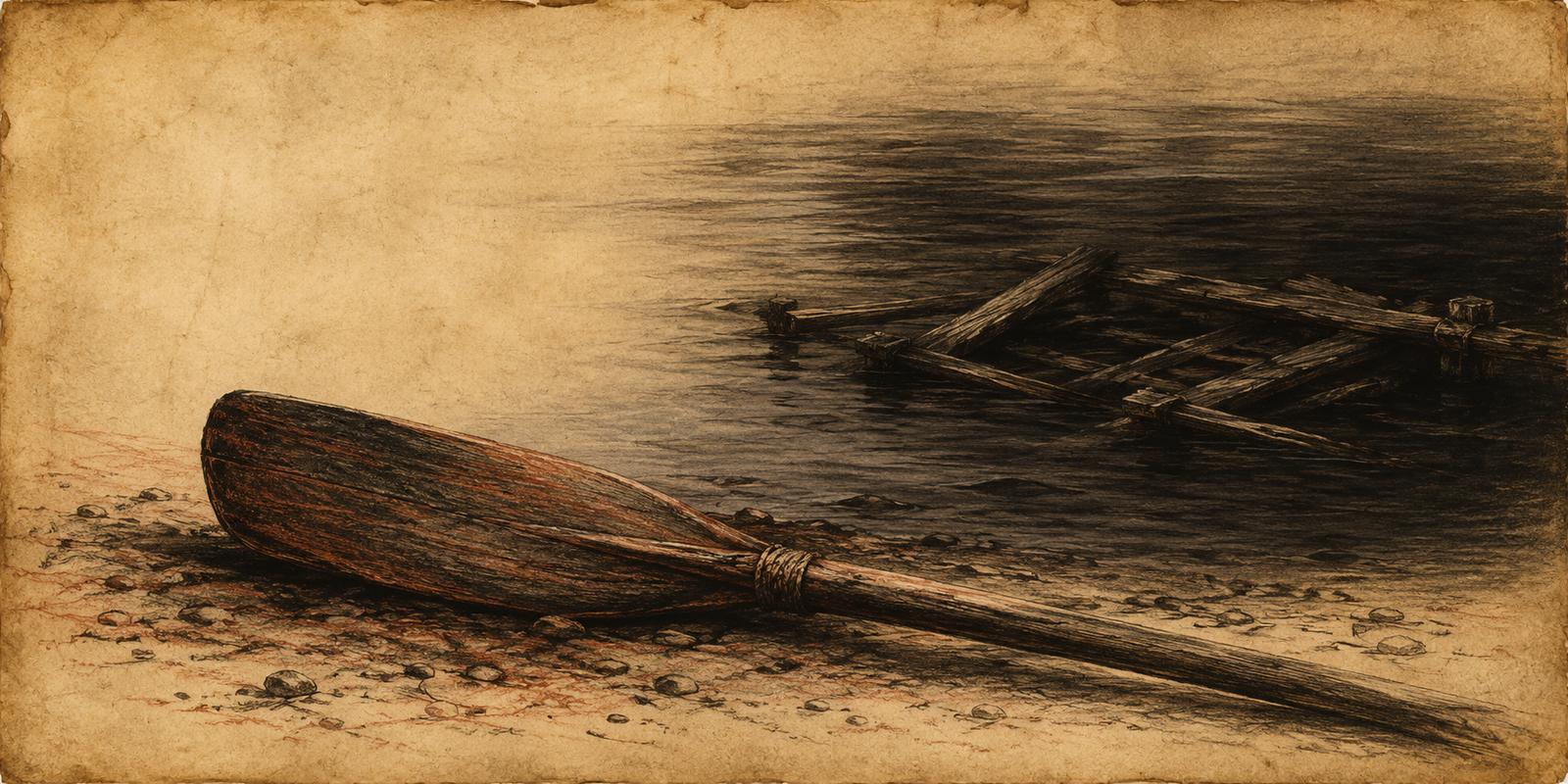

The Long Return V — From the Goddess to the Storm
In this fifth instalment of The Long Return, Homer’s Odyssey reaches the island of Calypso: a place of beauty, shelter, song, and almost unbearable safety.
Odysseus has been absent from his own story for a long time. Until now, he has existed as rumour, memory, contested image, father-shaped absence, and tale told by others. Here, at last, he appears — not in triumph, not in command, but sitting beside the sea, looking toward a home he cannot see.
Calypso offers him what no mortal man should easily refuse: safety, beauty, immortality, and the end of suffering. But safety can become another form of exile. To remain untouched by age, danger, and grief would also mean remaining outside the mortal obligations that make a life answerable.
The road home is not safe. It is not even a road. It is the sea.
Excerpt from The Long Return V — From the Goddess to the Storm:
Each day he went down to the shore and looked at the road that would not hold still.
Behind him, the island stood green and faultless. The trees were heavy with leaves. The air had the softness of a place where winter had never learned the way in. Vines climbed over the mouth of the cave, and the cave itself opened into cool stone and shadow, with a fire kept bright, and tables laid, and a bed where no draught came through the wall. There was food enough. There was wine enough. There was music when the goddess sang, and light on the loom when she wove.
There was, in short, almost everything a tired man might have begged from the gods if he had not known himself better.
Odysseus sat where the grass gave way to sand. He sat with his cloak gathered round him and his hands loose between his knees, and he watched the sea until the watching hurt. Sometimes he spoke aloud, though no man was there to answer him. Sometimes he said nothing from dawn until the shadows lengthened behind him. The gulls cried. The water came forward and withdrew. The horizon remained exactly where it was.
That was the cruelty of it. A road one cannot step onto is worse than a wall. A wall is at least honest.
For seven years Calypso had kept him there.
She had not kept him in chains. That would have been simpler, and the world is rarely kind enough to make its prisons simple. She had kept him with shelter, with beauty, with a god’s patience, and with a love that had no use for time. She had given him a place where no old age waited at the door, where no man insulted him, where no child asked why he had not returned, where no wife had to decide whether grief was faithfulness or merely habit.
She had given him safety.
Odysseus had learned the shape of safety by then.
It was the cave behind him.
It was the fire that never failed.
It was the voice of the goddess calling him from the shore, not in anger, but in sorrow.
It was waking each morning and finding that nothing had changed.
A man may endure danger for a long time. Some men, and Odysseus was certainly one of them, may even begin to think clearly inside it. But changelessness is a different trial. It does not strike. It surrounds. It does not kill the body. It teaches the soul to forget its own edges.
So each day he went down to the shore and looked toward Ithaca.
The full instalment follows Odysseus from Calypso’s island into the mortal labour of raft-building, the open sea, Poseidon’s storm, and the small mercy that leaves him hidden under leaves at the edge of the Phaeacian world.
Continue reading: The Long Return V — From the Goddess to the Storm at The Hospitable Dark on Substack.
Also in The Hospitable Dark

The Long Return VII — The Palace of Alcinous
Odysseus reaches the palace of Alcinous, but safety is not yet home. In this seventh instalment of The Long Return, hospitality becomes a moral test: a good house receives the stranger’s body before demanding his story.

When Favour Is Mistaken for Right — On Bellerophon
A companion essay to Bellerophon — The Bridle and the Fall, exploring Pegasus, divine favour, the bridle, heroic ascent, and the danger of mistaking help for permanent right. From The Hospitable Dark, this essay asks why Bellerophon’s tragedy is not false greatness exposed, but real help wrongly remembered.

Bellerophon — The Bridle and the Fall
A literary Greek myth retelling of Bellerophon, Pegasus, and the divine bridle: a tale of heroic ascent, misremembered grace, and the moment a true gift becomes proof in the wrong hands. From The Hospitable Dark, where old stories are retold in a warm, grave voice.
Continue Reading
If this piece found something in you, you may wish to continue the journey elsewhere.
On The Lantern Chronicles, I gather writings from Angkor, myth and legend, contemplative essays, and poetry — works shaped by silence, beauty, wonder, memory, and the deeper questions that follow us through the world.
It is a place for stone and story, reflection and vow, shadow and revelation.
You would be most welcome there.