
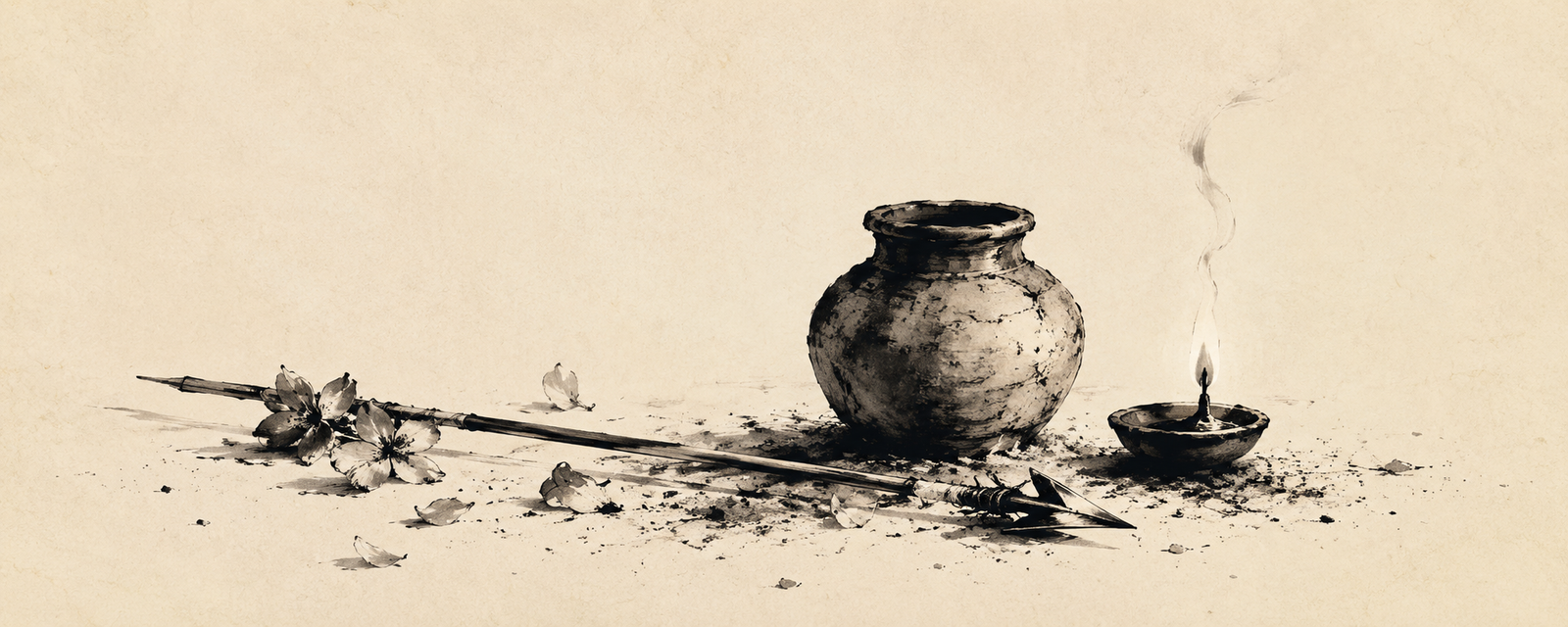

Desire Turned to Ash — Shiva and Kama Retold
Fires of the Old World XVIII — Desire Turned to Ash is a hearthlit retelling of Shiva, Kama, Rati, and Parvati: a tale of a flower-arrow, a third eye, and desire changed by fire. It begins not with spectacle, but with a child, a grandmother, a lamp, and a small vial of ash beside the flame.
On the high slopes, where the stones stayed cold after sunset and the lamp oil smelt faintly of sesame, a child sat beside his grandmother and listened to the wind.
The old woman had placed a small clay vial near the flame.
“What is inside?” the child asked.
“Ash,” she said.
The child looked towards the dark window, where the mountain air pressed its cool face against the shutters.
“Whose ash?”
The grandmother turned the vial once between her fingers. It made the smallest sound against her ring.
“Come closer,” she said. “This is a tale for those who have felt spring arrive too sharply.”
—
In those days Shiva sat upon the mountain.
He sat where the snow did not melt, where the white peaks rose like folded hands, where the sky seemed too clear for any living thing to enter. His hair was matted. His eyes were closed. The crescent moon rested in the dark of his locks, and the river hid itself there, held in silence.
Around him, the stones forgot warmth.
A serpent lay at his throat without stirring. Ash marked his skin. The wind came near him and lost its voice. Birds crossed the air above him and did not cry.
Far below, people lit lamps and spoke his name softly.
Far below, mothers pressed children close when the earth shook.
For an asura had grown strong. His steps bruised the fields. His laughter darkened the halls of the devas. Spears had broken against him. Prayers had risen and come back thin. It was said that only a son of Shiva could bring the terror down.
But Shiva sat beyond longing.
He had gone where no hand could call him back. He had taken the world’s noise and laid it under ash. He had passed beyond hunger, beyond dream, beyond the bright ache of being seen.
Then Parvati came to the mountain.
She came without thunder.
Each morning she climbed the cold path with bare feet and a small brass lamp cupped in both hands. Sometimes she brought wild flowers. Sometimes she brought a lotus from a lower pool, its stem wrapped in a wet cloth. Sometimes she brought nothing but her own breath, white in the air.
She swept the stones before him.
She cleared fallen needles from the place where he sat.
She set the lamp down and shielded the flame until it caught.
Shiva did not open his eyes.
The snow lay still on his shoulders.
Day after day Parvati came. Frost bit her fingers. Wind pulled at her hair. Once a stone cut her heel, and she left a red mark on the pale path. She washed it away before she reached him. She would not bring blood into that silence.
Still Shiva did not open his eyes.
So the devas grew afraid.
They gathered where the sky was thin and the scent of smoke from human altars barely reached them. One still held a broken spear. Another had ash on his crown from a shrine burned in the night. No one spoke loudly.
“No weapon wakes him,” said one.
“No praise wakes him,” said another.
“No fear wakes him,” said a third.
Then someone spoke the name they had avoided.
“Kama.”
A hush passed among them.
The full tale continues as Kama comes to the mountain with a sugarcane bow, a string of bees, and an arrow tipped with blossom.
Continue reading: Fires of the Old World XVIII — Desire Turned to Ash at The Lantern Chronicles on Substack.
Also in The Lantern Chronicles

The Stranger Is Where Inheritance Is Weighed
A Living Way essay on faith, inheritance, empire, and moral humility. The Stranger Is Where Inheritance Is Weighed asks how the stories that form us can become either mercy or contempt — and why the true test of any tradition is whether it can still see the stranger.
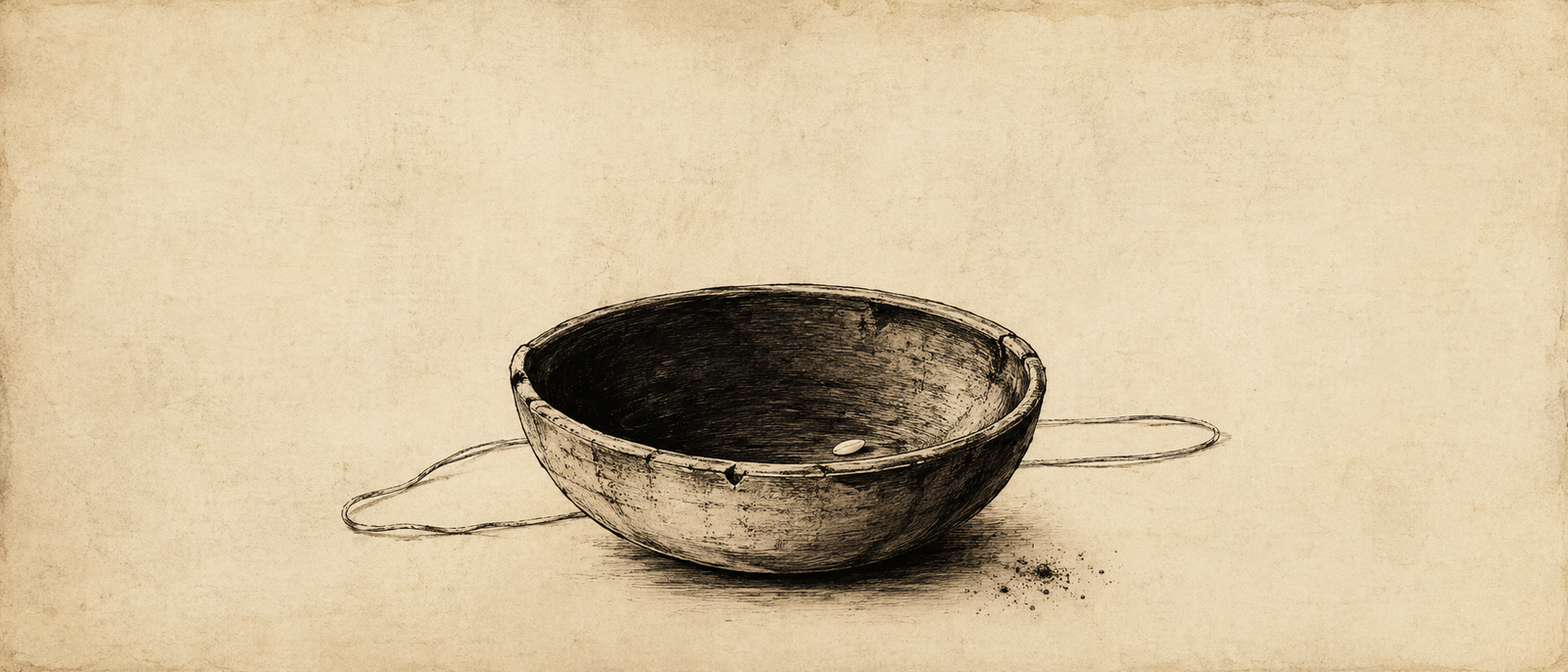

The Beggar God: A Bhikshatana Retelling
A hearthlit retelling of Bhikshatana: Shiva enters the forest as a barefoot beggar, carrying only ash, silence, and an empty bowl. In this Fires of the Old World tale, spiritual pride is not defeated by argument or spectacle, but revealed by what the hand cannot yet release.

At the Lip — A Poem from The Vow
A poem from The Vow on a waterfall, a river reaching the edge, and the stillness that gives falling its shape. At the Lip stays with one overwhelming natural image until movement, constraint, and scale become almost unbearable in their precision.
Continue Reading
If this piece found something in you, you may wish to continue the journey elsewhere.
On The Lantern Chronicles, I gather writings from Angkor, myth and legend, contemplative essays, and poetry — works shaped by silence, beauty, wonder, memory, and the deeper questions that follow us through the world.
It is a place for stone and story, reflection and vow, shadow and revelation.
You would be most welcome there.