
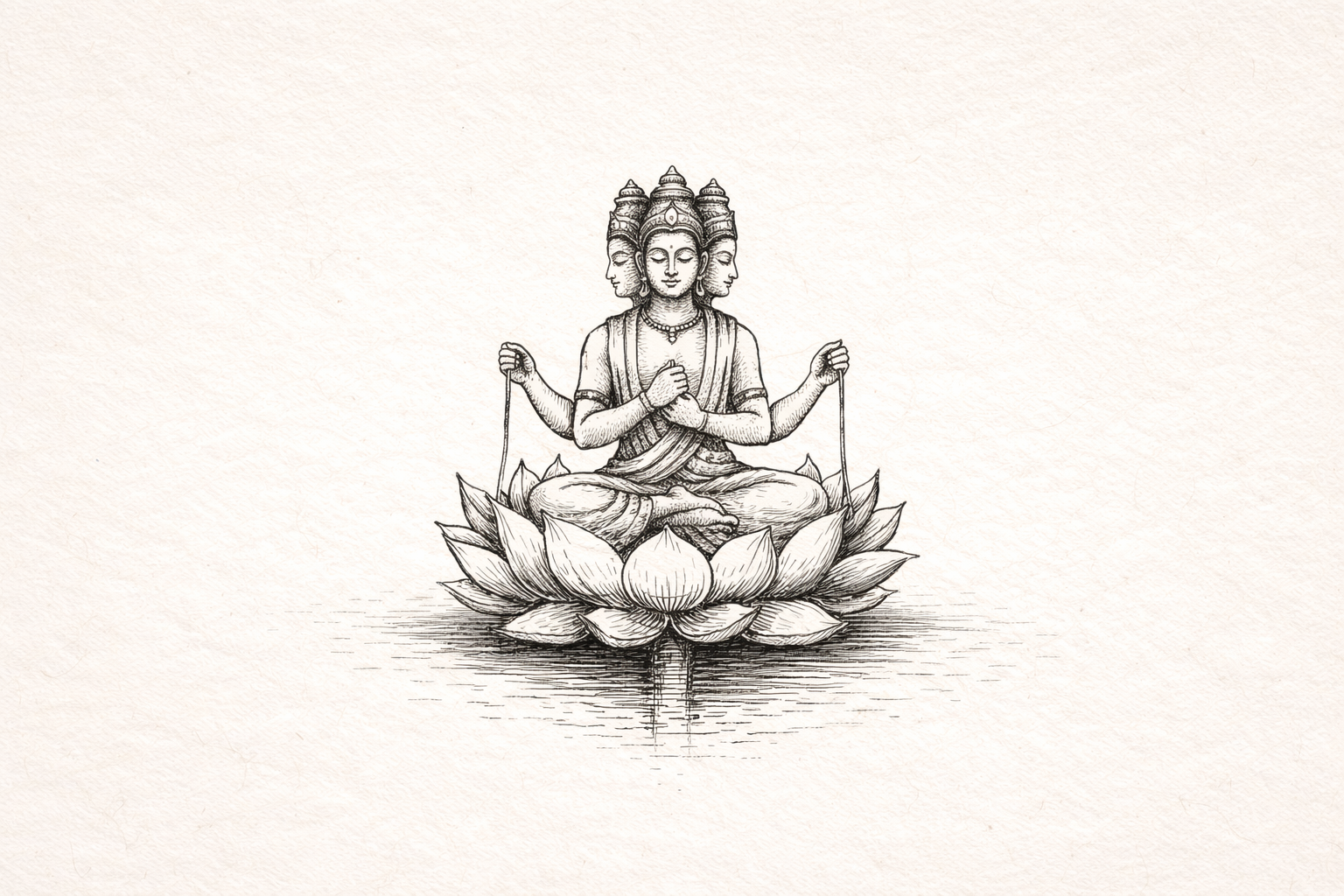

Fires of the Old World II — Lotus-Birth
Fires of the Old World II — Lotus-Birth continues the series at the edge of creation: the Sleeping God beneath the waters, the lotus rising from divine stillness, and Brahma awakening into the first burden of making. This is a tale of depth, measure, fear, labour, and the terrible tenderness of a world that must be shaped because no bottom has yet been given.
The lamp had been trimmed, and the oil stood still as held breath. Outside the door the night insects stitched their small, ceaseless music; inside there was ember-scent and cool air. A child lay half-asleep beneath a woven cloth; an old woman warmed her palms over ash and listened. The house was nothing grand—reed, timber, soot—yet the dark beyond it felt wide as water.
In such a night, stories do not arrive like guests.
They rise like smoke.
Listen.
Before there was counting, before there was name, there was the Sleeping God.
He did not lie as men lie, with knees drawn and ribs complaining. He lay as a mountain lies beneath cloud: whole, unhurried, complete. Around him the waters rolled—black, deep, unmeasured—touching him as reverently as lips touch a shrine. The world had not yet learned edge or direction. It was only water and the slow pulse of a presence so immense that even the dark was gentle in its shadow.
And in that presence, a lotus seed waited.
It was no bigger than a grain caught beneath a fingernail, no heavier than a thought not yet spoken. It rested at the Sleeping God’s navel, as though the body itself had kept a secret there. The seed held everything in its silence: lamp and ash, coil-scale and measuring cord, the first taste of breath.
Time went past as it does when no one is watching. The waters shifted their shoulders. The deep kept its patience.
Then the lotus seed warmed.
Not with fire, but with quiet will. The seed swelled. It drank the ocean without diminishing it. Slowly, with tenderness that did not ask permission, it opened.
A stalk rose.
It rose from the navel of the divine like a column drawn from the centre of silence. It rose straight through the black waters, unwavering. The waters did not resist it; they made way, as though they had been waiting for this exact ascent. The stalk carried a pale strength, the kind found in reeds and vows—something that will not yield merely because the world is wide.
Up it went.
Past distances without names. Past depths that had never been sounded. Past the place where a fish might one day learn fear. Past the place where a serpent dreamed—coiled into patience, scale upon scale—though no eye had yet been made to witness it.
At last, where the dark thinned a little, the lotus blossomed.
It unfolded as if it had been practising for ages. Petal after petal opened, each one a pale curve, each one a promise made visible. In its heart, cradled as in a small, perfect bowl, sat a being with four faces and four calm, unhurried hands.
Brahma opened his eyes.
The first thing he saw was lamp-light that had not yet been lit. The second was ash that had not yet cooled. The third was the curve of a measuring cord, slack in the palm of a world not yet measured.
He sat upon the lotus as a judge sits: not severe, not kind, simply present. He breathed in, and his breath did not move air—because air had not yet been made—but it moved possibility.
Continue reading: Fires of the Old World II — Lotus-Birth at The Lantern Chronicles on Substack.
Also in The Lantern Chronicles

The Stranger Is Where Inheritance Is Weighed
A Living Way essay on faith, inheritance, empire, and moral humility. The Stranger Is Where Inheritance Is Weighed asks how the stories that form us can become either mercy or contempt — and why the true test of any tradition is whether it can still see the stranger.
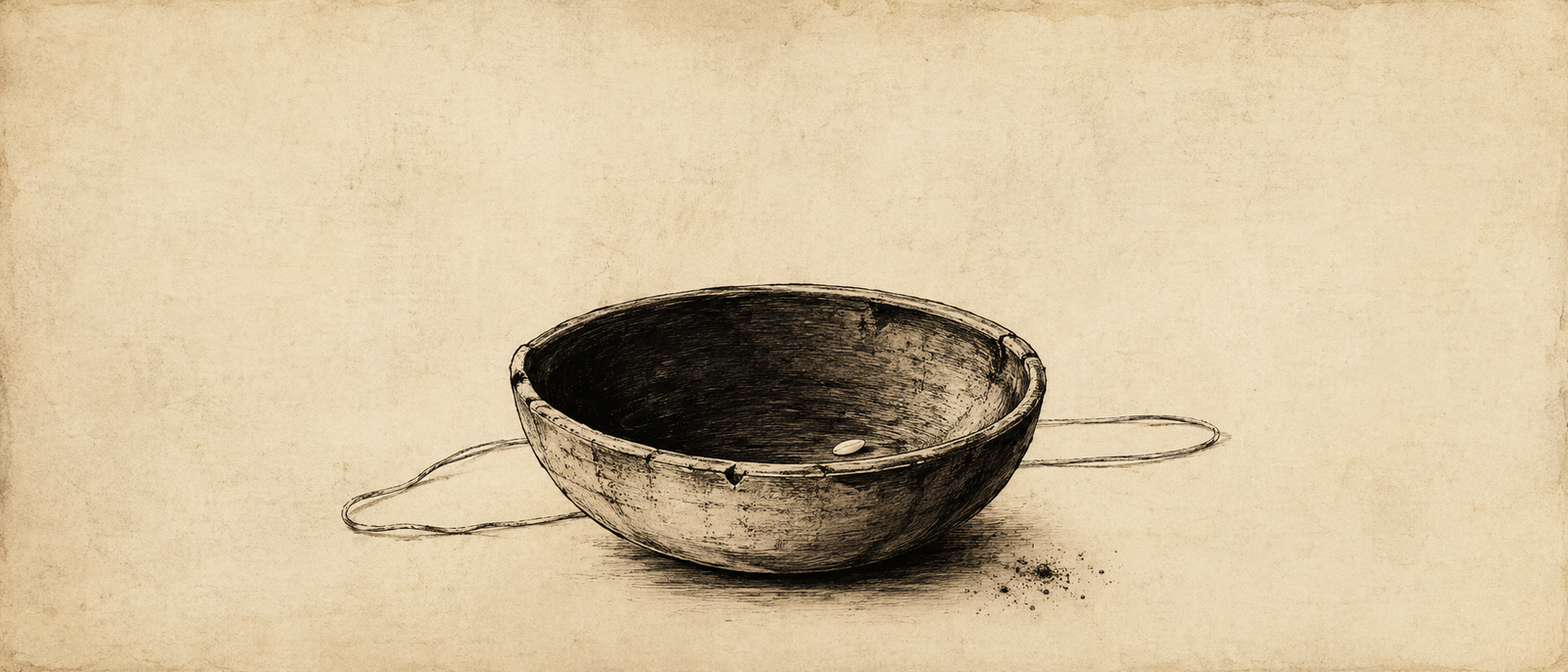

The Beggar God: A Bhikshatana Retelling
A hearthlit retelling of Bhikshatana: Shiva enters the forest as a barefoot beggar, carrying only ash, silence, and an empty bowl. In this Fires of the Old World tale, spiritual pride is not defeated by argument or spectacle, but revealed by what the hand cannot yet release.

At the Lip — A Poem from The Vow
A poem from The Vow on a waterfall, a river reaching the edge, and the stillness that gives falling its shape. At the Lip stays with one overwhelming natural image until movement, constraint, and scale become almost unbearable in their precision.
Continue Reading
If this piece found something in you, you may wish to continue the journey elsewhere.
On The Lantern Chronicles, I gather writings from Angkor, myth and legend, contemplative essays, and poetry — works shaped by silence, beauty, wonder, memory, and the deeper questions that follow us through the world.
It is a place for stone and story, reflection and vow, shadow and revelation.
You would be most welcome there.