
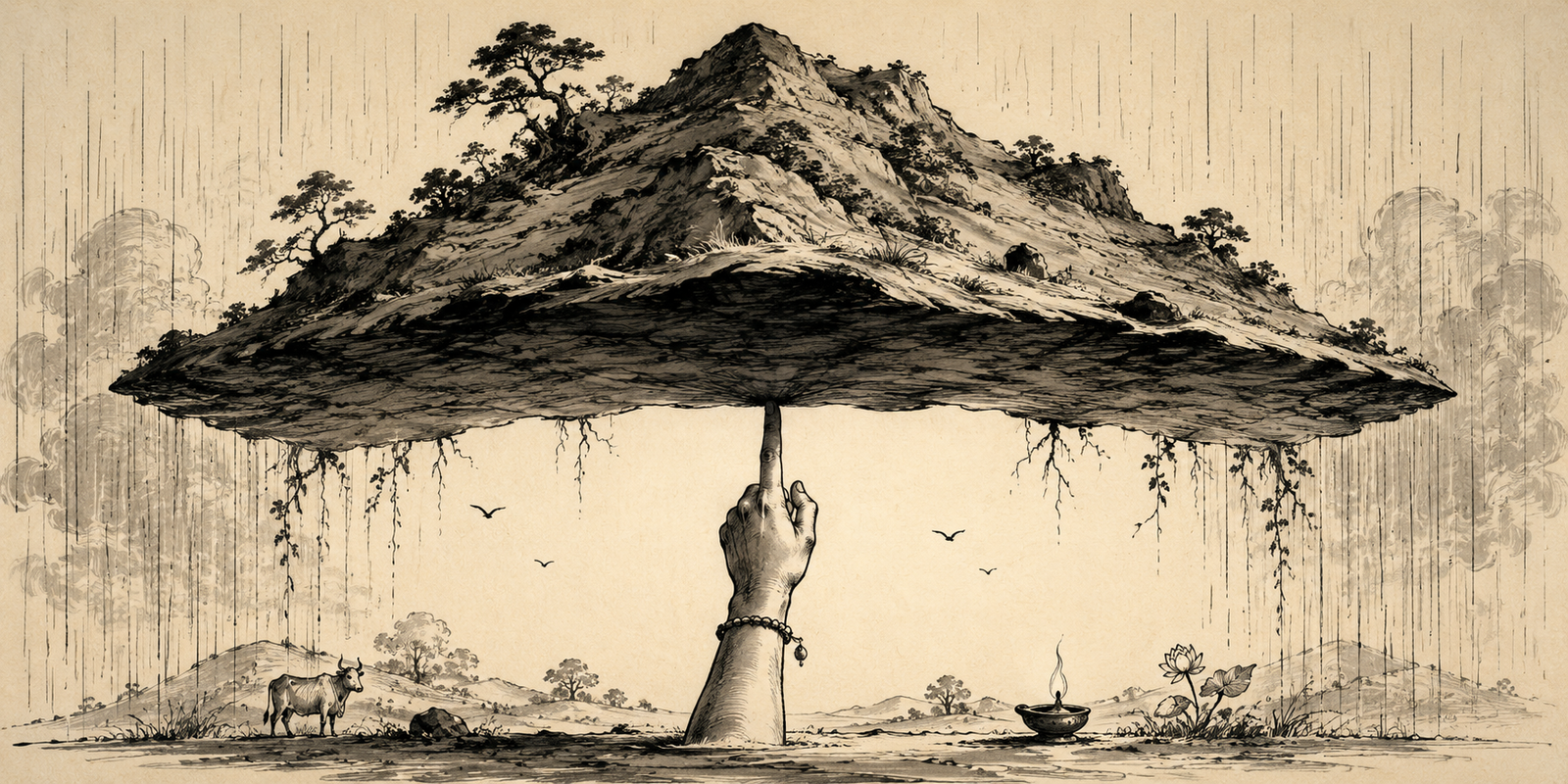

The Lifted Mountain — A Krishna and Govardhana Retelling
In Fires of the Old World XVII — The Lifted Mountain, the Govardhana episode is retold as a hearthlit tale of rain, shelter, village life, and the child whose raised hand becomes a place of refuge.
This is not a tale of spectacle first. It begins with wet stone, lamp-smoke, an old woman, and a child listening while rain gathers at the edge of the room.
The old woman told it when the rain had made the courtyard shine.
All evening the eaves had dripped. The stone step was cold under the child’s bare heels, and the lamp-smoke smelled of oil and blackened cotton. Beyond the door, frogs called from the wet grass. The grandmother drew the child nearer with one dry hand.
“Listen,” she said. “This is a tale for rain.”
The child looked at the lamp.
The flame bent once, as if it too had heard.
—
In the cowherd village at the foot of Govardhana, the rains had always been honoured.
When the season turned, the women washed the stones. The men brought milk, curds, grain, butter, and garlands. The children ran behind them with wet feet and bright mouths. The calves wore little strings around their necks. The bulls shook their horns and rang their bells.
Above them stood the mountain.
It was not the highest mountain in the world. It did not tear the sky. It did not wear snow. It rose green and broad above the grazing land, with caves in its sides, peacocks in its groves, herbs on its slopes, and springs that tasted of stone.
The people loved it without saying so.
They leaned on it with their eyes.
That year, as the offerings were being prepared, Krishna came among them.
He was still young enough for the mothers to look for mud on his knees. His hair was dark from the rain. A peacock feather clung to him as if it had chosen him. Around his wrist was a little coil-scale charm one of the boys had found near the stream, smooth as a fingernail and dark as wet seed.
He watched the men stack pots of butter.
He watched the women tie lotus buds with thread.
He watched the old priest measure the ground with a cord before placing the fire-stones.
“Why are these things gathered?” Krishna asked.
The old priest smiled, because everyone smiled when Krishna asked a question.
“For the lord of rain,” he said.
Krishna looked up.
Clouds moved like dark cattle across the sky.
“And who feeds our cows?” he asked.
“The grass,” said one boy.
“And who feeds the grass?”
“The rain,” said another.
“And where does the rain rest when it has fallen?”
No one answered at once.
Krishna touched the wet earth with his toes.
“It rests here,” he said. “On Govardhana. In the grass. In the leaves. In the streams. In the hollow where the calf drinks. In the field where the grain bends. Why send our thanks so far away that they forget the path home?”
The priest lowered the measuring cord.
A pot of curds slipped in a woman’s hands, but she caught it against her hip.
Nanda, Krishna’s father, stood under the edge of the cattle shed. Rain ticked from the thatch beside his shoulder.
“Child,” he said gently, “these are old ways.”
Krishna turned to him.
“Then let them be old enough to be true.”
From there, the offering turns toward the mountain itself. The village honours Govardhana, the grass, the cows, and the hands that work in rain. For one evening, the sky seems to understand.
Then the rain changes.
Continue reading: Fires of the Old World XVII — The Lifted Mountain at The Lantern Chronicles on Substack.
Also in The Lantern Chronicles

The Stranger Is Where Inheritance Is Weighed
A Living Way essay on faith, inheritance, empire, and moral humility. The Stranger Is Where Inheritance Is Weighed asks how the stories that form us can become either mercy or contempt — and why the true test of any tradition is whether it can still see the stranger.
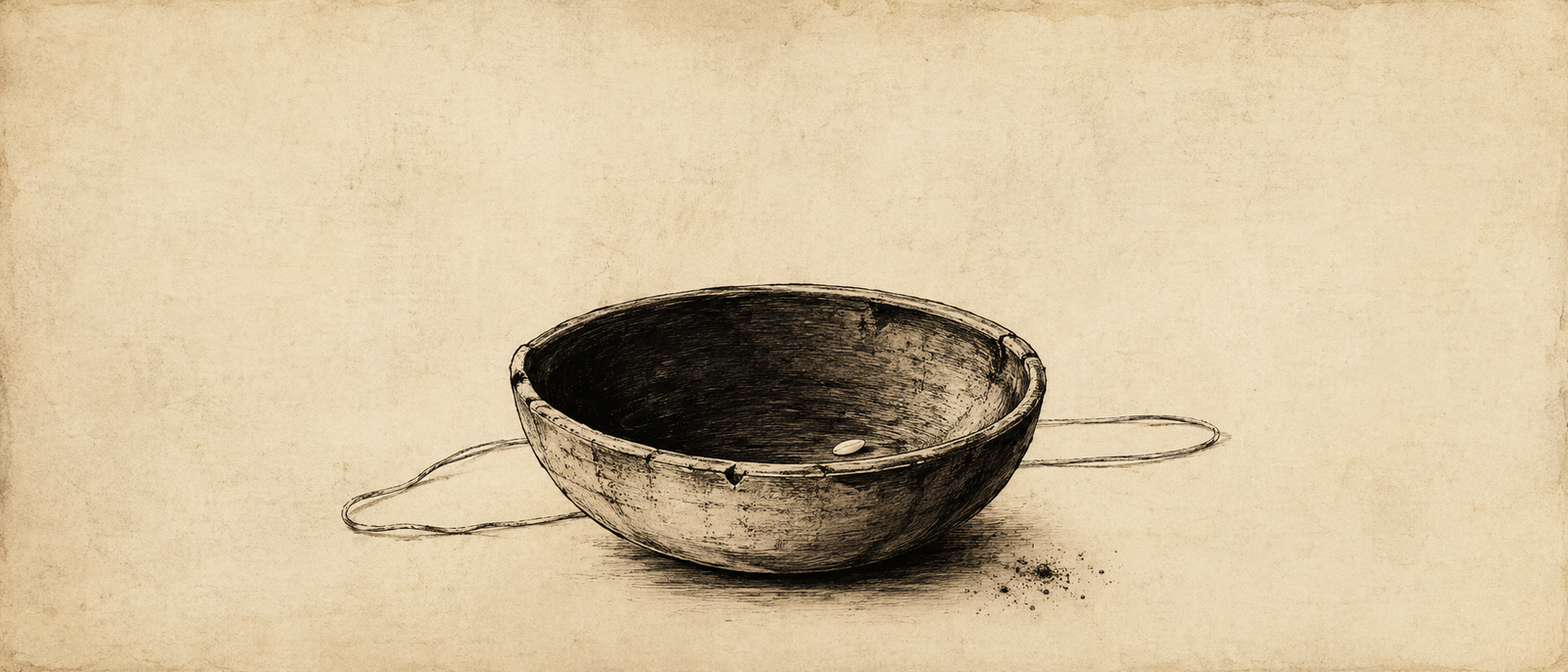

The Beggar God: A Bhikshatana Retelling
A hearthlit retelling of Bhikshatana: Shiva enters the forest as a barefoot beggar, carrying only ash, silence, and an empty bowl. In this Fires of the Old World tale, spiritual pride is not defeated by argument or spectacle, but revealed by what the hand cannot yet release.

At the Lip — A Poem from The Vow
A poem from The Vow on a waterfall, a river reaching the edge, and the stillness that gives falling its shape. At the Lip stays with one overwhelming natural image until movement, constraint, and scale become almost unbearable in their precision.
Continue Reading
If this piece found something in you, you may wish to continue the journey elsewhere.
On The Lantern Chronicles, I gather writings from Angkor, myth and legend, contemplative essays, and poetry — works shaped by silence, beauty, wonder, memory, and the deeper questions that follow us through the world.
It is a place for stone and story, reflection and vow, shadow and revelation.
You would be most welcome there.