

What Cannot Be Finished
In What Cannot Be Finished, Lucas Varro turns to the quiet dignity of maintenance: the oiled hinge, the washed cup, the mended seam, the repeated act of care by which ordinary life is kept in being. The essay asks what changes when we stop imagining the good life as a finished state, and begin to recognise that much of what matters survives only through return.
This is a Living Way essay on maintenance, fidelity, recurrence, and the life that must be tended rather than mastered.
The hinge has begun to complain again.
Not loudly. Just enough that when the door opens in the early morning, before the kettle has boiled and before the room has properly entered the day, the sound is there: a thin, ungenerous note of friction, metal reminding metal that use leaves its mark. It would be easy to ignore for another week. Easier still to resent. But eventually the small bottle is found, the drop of oil placed where it needs to go, the door opened and closed once, then again, until the complaint softens back into silence.
Nothing has been achieved, exactly.
Nothing has been built. Nothing has advanced. A hinge has been tended. By tomorrow there will be some other small disorder asking for its turn: dust gathering where the light falls, cloth fraying at the seam, water marks returning to the sink, a plant leaning too far towards the window, the old impatience returning in thought, the old misalignment returning in speech.
Much of life takes this form.
Not breakthrough, but re-attention.
Not completion, but return.
Not mastery, but upkeep.
We imagine otherwise. We imagine that the serious life will look more finished than this. One day the room will remain in order. The body will become reliable. Character will settle into its best shape and stay there. Love will have learned enough not to require such frequent repair. The mind will at last stand clear of its old confusions. What is good will become secure through being fully won.
But most of what matters does not become secure in that way. It remains within reach only by being taken up again.
A cup is washed and used again. A floor is swept and gathers dust again. Bread is bought, eaten, bought again. A conversation is resumed after strain. A promise is remembered in the hour when it would be easier to forget it. A practice of attention is resumed by someone who lost it yesterday and will lose it again tomorrow. Even sorrow does not move cleanly onward. It shifts, recedes, returns under new weather, asks to be carried in a different way.
There is a humility in this recurrence that pride finds difficult to forgive.
We are drawn to finished things because they seem to stand beyond embarrassment. They do not show too much of the hand. They do not confess how often they had to be corrected, steadied, salvaged, brought back from drift. The finished thing appears to have arrived under its own power. We are tempted to want the same composure for ourselves. Not simply order, but exemption. Not simply form, but freedom from the labour of maintaining form.
And yet the lives we actually inhabit are not monuments. They are things kept in being.
That distinction goes deeper than it first appears. A monument asks to be admired. A living thing asks to be tended. One can walk away from the monument and leave it to weather on its own terms. But a friendship, a craft, a conscience, a household, a body, a marriage, a discipline of thought — these do not remain true by being established once. They remain true, where they do remain true, by repeated acts of noticing, correction, renewal, restraint, patience.
A person returns to the same failing and tries to speak more gently.
A person folds the cloth and lays it back in its place.
A person replaces the torn seam rather than throwing the garment aside.
A person clears the table at evening though it will be cluttered again tomorrow.
A person begins again in the one unfinished self available.
Continue reading: What Cannot Be Finished at The Living Way on Substack.
Also in The Lantern Chronicles

The Stranger Is Where Inheritance Is Weighed
A Living Way essay on faith, inheritance, empire, and moral humility. The Stranger Is Where Inheritance Is Weighed asks how the stories that form us can become either mercy or contempt — and why the true test of any tradition is whether it can still see the stranger.
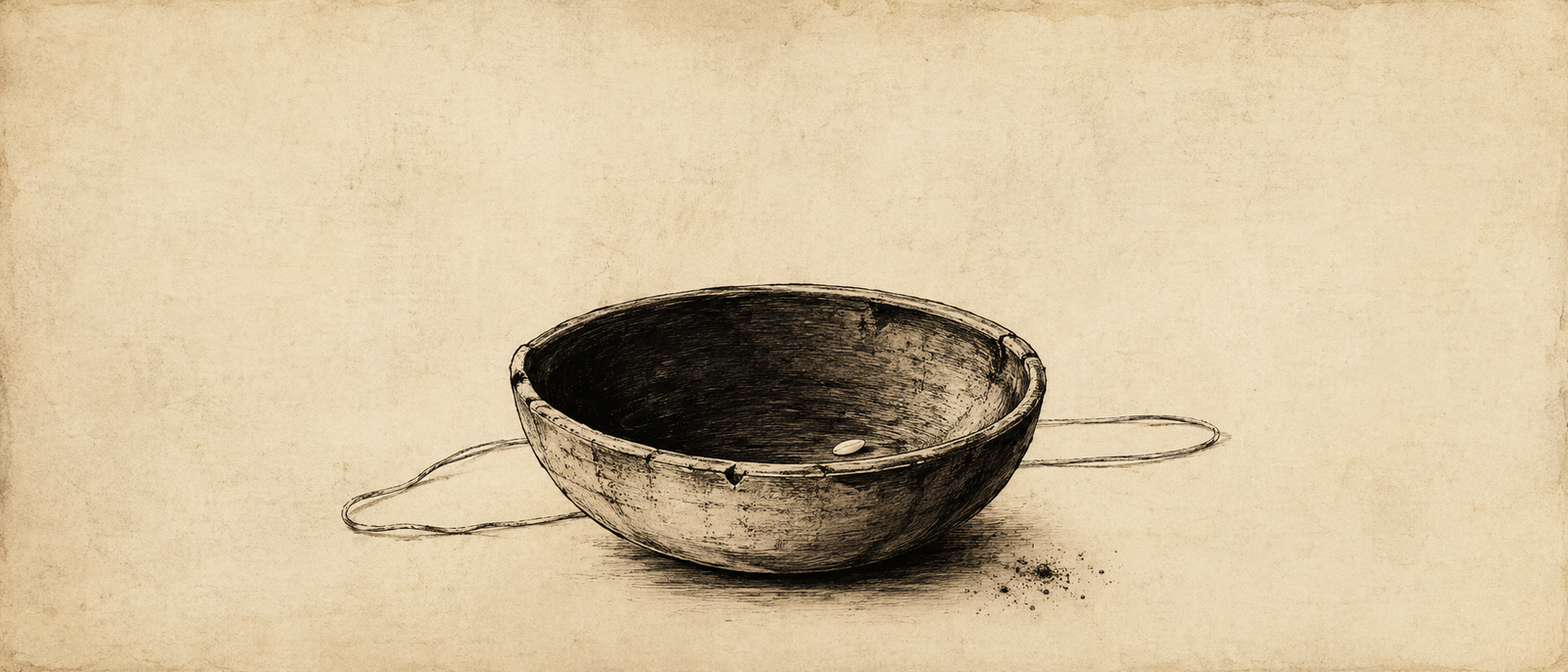

The Beggar God: A Bhikshatana Retelling
A hearthlit retelling of Bhikshatana: Shiva enters the forest as a barefoot beggar, carrying only ash, silence, and an empty bowl. In this Fires of the Old World tale, spiritual pride is not defeated by argument or spectacle, but revealed by what the hand cannot yet release.

At the Lip — A Poem from The Vow
A poem from The Vow on a waterfall, a river reaching the edge, and the stillness that gives falling its shape. At the Lip stays with one overwhelming natural image until movement, constraint, and scale become almost unbearable in their precision.
Continue Reading
If this piece found something in you, you may wish to continue the journey elsewhere.
On The Lantern Chronicles, I gather writings from Angkor, myth and legend, contemplative essays, and poetry — works shaped by silence, beauty, wonder, memory, and the deeper questions that follow us through the world.
It is a place for stone and story, reflection and vow, shadow and revelation.
You would be most welcome there.