
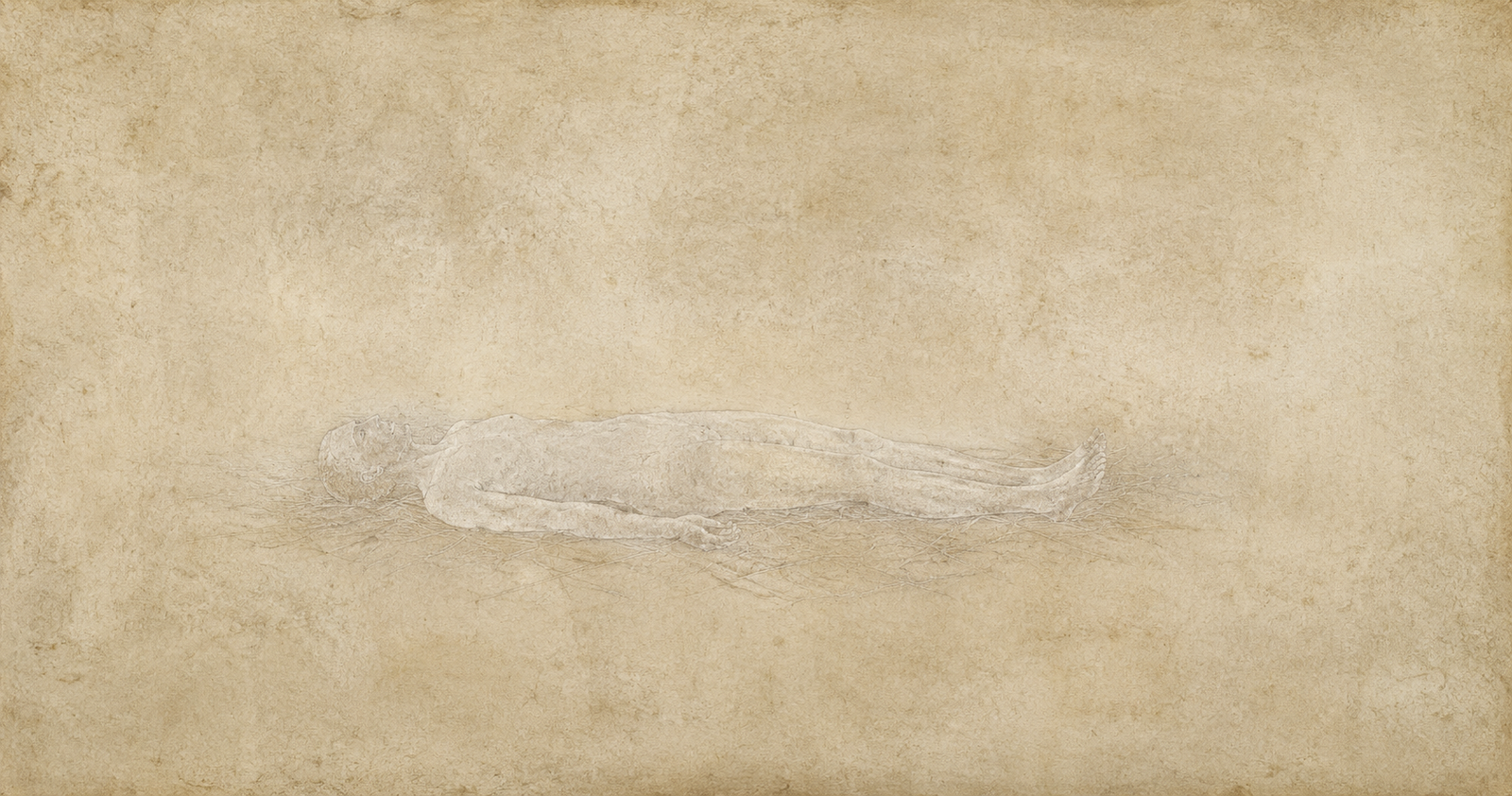

The Body on the Sacred Grass: A Vedic Myth Retelling
In the Purusha Sukta of the Rigveda, creation does not begin with a word spoken into emptiness. It begins with an immeasurable body and a sacrifice whose victim already contains the world.
The Body on the Sacred Grass is a source-faithful literary rendering of that ancient Vedic hymn, written as a companion to the Mytharium essay The Body That Became the World.
Purusha had a thousand heads,
a thousand eyes,
a thousand feet.
He covered the earth on every side and still stood ten fingers’ breadth beyond it.
All that had been was Purusha.
All that would be was Purusha.
He was lord of immortality, growing beyond through food. Yet all beings were only one quarter of him. Three quarters remained beyond them, deathless in the heights.
Three quarters rose above.
One quarter entered the world.
From that quarter he spread into what eats and what does not eat, behind and before, across all the earth.
From Purusha came Viraj.
From Viraj, Purusha came again.
The one brought forth the other, and the other returned him to the beginning. Neither stood wholly before the other. Birth circled back upon itself.
Then the gods prepared the sacrifice.
Spring became the clarified butter.
Summer became the fuel.
Autumn became the offering.
The sacred grass was spread upon the ground.
Upon it they laid Purusha, born at the beginning.
The gods gathered around him. With them came the ancient powers and the seers. They sprinkled the offering and made ready the rite.
The earth lay beneath him, though the earth was within him.
The sky waited above him, though the sky had not yet been shaped.
The fire that would receive the offering had come from the one who was offered.
The gods sacrificed Purusha.
From the complete offering, abundance gathered.
From it came the creatures of the air, lifting themselves above the earth. From it came the animals of the forest, moving beyond the boundaries of fire and dwelling. From it came the animals that remained near human beings, sleeping beside the fence and feeding within sight of the hearth.
Horses came from the sacrifice.
Cattle came from it.
Goats and sheep came from it.
What had been held within one body now went forth in many bodies: hoof and horn, feather and hide, breath passing from creature to creature beneath the same sky.
From the offering came the verses of the Rig.
From it came the chants of the Saman.
From it came the metres that gave sacred speech its measure.
From it arose the formulas of the Yajus.
The first sacrifice brought forth the words by which sacrifice would be remembered and performed again.
But the division of Purusha has only begun. The hymn must still ask what became of his mouth, arms, thighs, and feet—and how moon, sun, wind, earth, sky, human order, and the directions themselves emerged from the body laid upon the sacred grass.
Continue reading: The Body on the Sacred Grass at The Mytharium on Substack.
Also in The Mytharium

The Joy Sorrow Cannot Foresee
Sam wakes beneath green leaves and asks whether everything sad will come untrue—but Frodo’s wounded hand already complicates the answer. This Mytharium essay explores Tolkien’s eucatastrophe, grace at Mount Doom, and the sudden joy that does not erase sorrow but denies it final authority.

The Body That Became the World
Before the world became separate things, the Rigveda gave it a body. This Mytharium essay reads the sacrifice of Purusha as an image of creation, sacred unity, social hierarchy, and the cost of becoming many.

Morgoth’s Ring: The World Evil Cannot Unmake
A serious Mytharium reading of Morgoth’s Ring, Arda Marred, Sauron, matter, evil, and Tolkien’s wounded but good world. The essay asks how deeply evil can enter creation without ever becoming its source.
Continue Reading
If this piece found something in you, you may wish to continue the journey elsewhere.
On The Lantern Chronicles, I gather writings from Angkor, myth and legend, contemplative essays, and poetry — works shaped by silence, beauty, wonder, memory, and the deeper questions that follow us through the world.
It is a place for stone and story, reflection and vow, shadow and revelation.
You would be most welcome there.