

The Joy Sorrow Cannot Foresee
Sam wakes beneath young beech leaves in Ithilien and asks the question on which Tolkien’s whole theory of story turns:
“Is everything sad going to come untrue?”
The answer before him seems to be yes.
Gandalf is alive. Frodo lies beside him. The Ring has been destroyed, the Dark Tower has fallen, and sunlight is moving through the leaves. Only hours earlier, Sam had believed that he and Frodo would die together upon the ruin of Mount Doom. Now the world has been given back to him. He laughs, and his laughter becomes weeping, and then he laughs again.
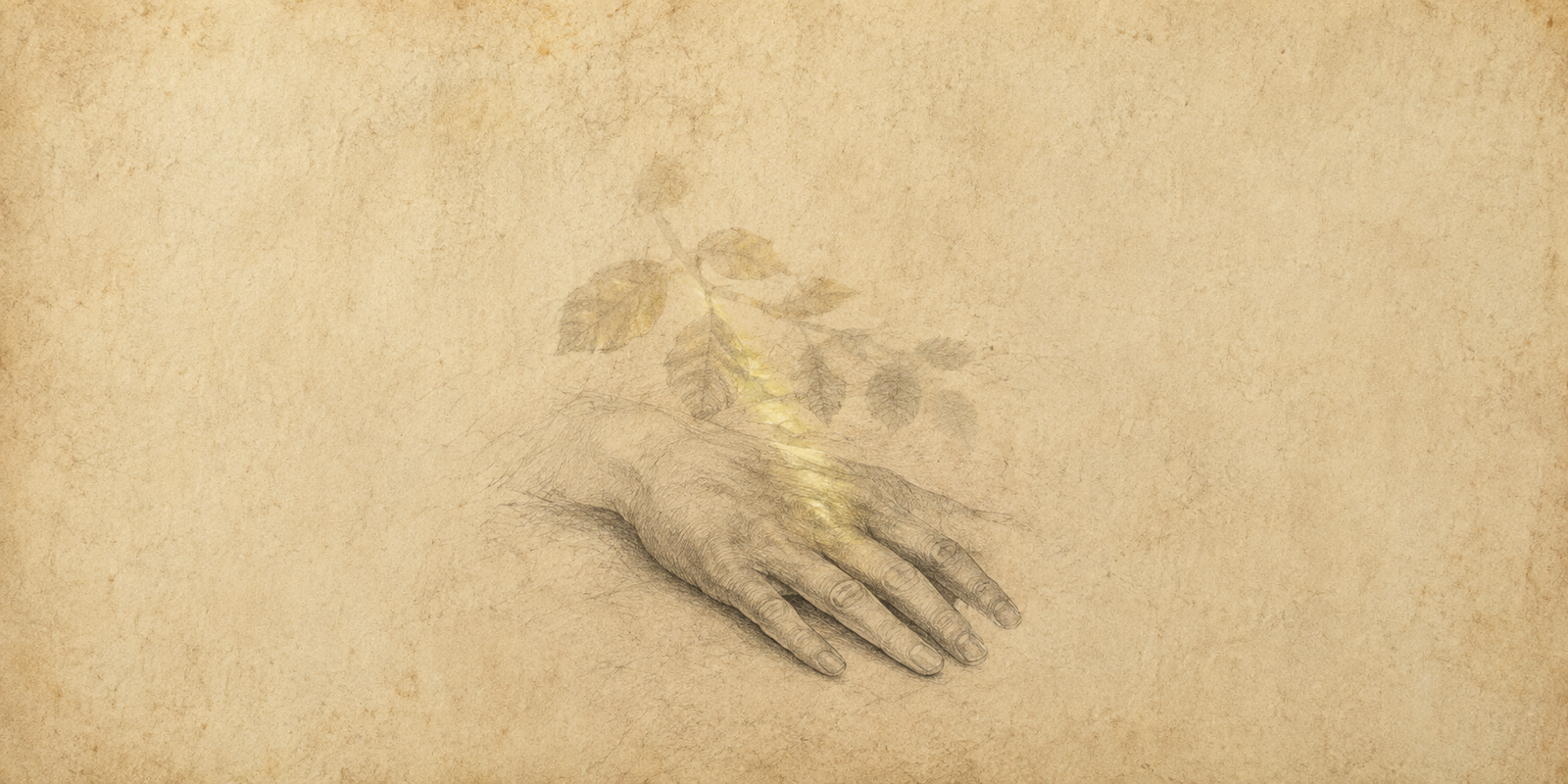
Yet Frodo’s hand is already altered.
One finger is missing. The wound has crossed with him into the restored world. Before the book closes, other wounds will reveal themselves: the knife, the sting, the long burden that cannot simply be set down when the object that caused it has vanished. Frodo will return to the Shire, but he will not be able to return to the life he left there. He has saved his home and lost the power to live wholly within it.
The scene contains the whole of Tolkien’s eucatastrophe: the joy is real, and so is the wound.
In “On Fairy-Stories,” Tolkien finds the ordinary language of happy endings inadequate to describe what the fairy-story can do. The ending he has in mind is not merely fortunate. It is not the moment when the deserving are rewarded, the enemy is defeated, and the pieces of the world are placed neatly back where they belonged.
A happy ending tells us that events have turned out well.
Eucatastrophe alters what we believe the whole story means.
It does not make the darkness imaginary. The danger must have been real, and defeat must have remained possible, or the turn has no power. Tolkien insists that eucatastrophe does not deny sorrow or failure. It denies something more absolute: universal final defeat.
The qualification matters more than the comfort.
A particular hope may fail. A beloved thing may be lost. A kingdom may fall, and a wound may remain beyond the reach of any healing available within the world. Tolkien’s stories do not lack such losses. Beleriand sinks. Númenor is drowned. The Elves diminish. Elrond and Arwen are parted. Túrin’s tale closes around a grief no mortal action can reverse.
Eucatastrophe does not declare that these things never happen.
It declares that they do not possess the final meaning of everything that happens.
This is why Tolkien’s joy is unlike optimism. Optimism reads the evidence and predicts improvement. Eucatastrophe comes when prediction has exhausted itself. It enters not from the visible tendency of events, but across it.
The sudden turn therefore cannot be separated from the wound through which it arrives. The Eagles do not make Thorin’s death unreal. The destruction of the Ring does not restore Frodo’s hand. Victory does not return him unchanged to the Shire.
Tolkien’s deepest consolation begins where easy consolation fails.
The full essay follows that movement from the Eagles and Mount Doom to Frodo’s departure, asking how grace may enter a story without denying the sorrow already written into the body.
Continue reading: The Joy Sorrow Cannot Foresee at The Mytharium on Substack
Also in The Mytharium

The Body on the Sacred Grass: A Vedic Myth Retelling
A source-faithful literary retelling of the Purusha Sukta from the Rigveda. The gods lay the immeasurable Purusha upon the sacred grass, and from the primordial sacrifice begin to emerge animals, ritual speech, human order, and the cosmos itself. Yet the world will receive only one quarter of him.

The Body That Became the World
Before the world became separate things, the Rigveda gave it a body. This Mytharium essay reads the sacrifice of Purusha as an image of creation, sacred unity, social hierarchy, and the cost of becoming many.

Morgoth’s Ring: The World Evil Cannot Unmake
A serious Mytharium reading of Morgoth’s Ring, Arda Marred, Sauron, matter, evil, and Tolkien’s wounded but good world. The essay asks how deeply evil can enter creation without ever becoming its source.
Continue Reading
If this piece found something in you, you may wish to continue the journey elsewhere.
On The Lantern Chronicles, I gather writings from Angkor, myth and legend, contemplative essays, and poetry — works shaped by silence, beauty, wonder, memory, and the deeper questions that follow us through the world.
It is a place for stone and story, reflection and vow, shadow and revelation.
You would be most welcome there.