
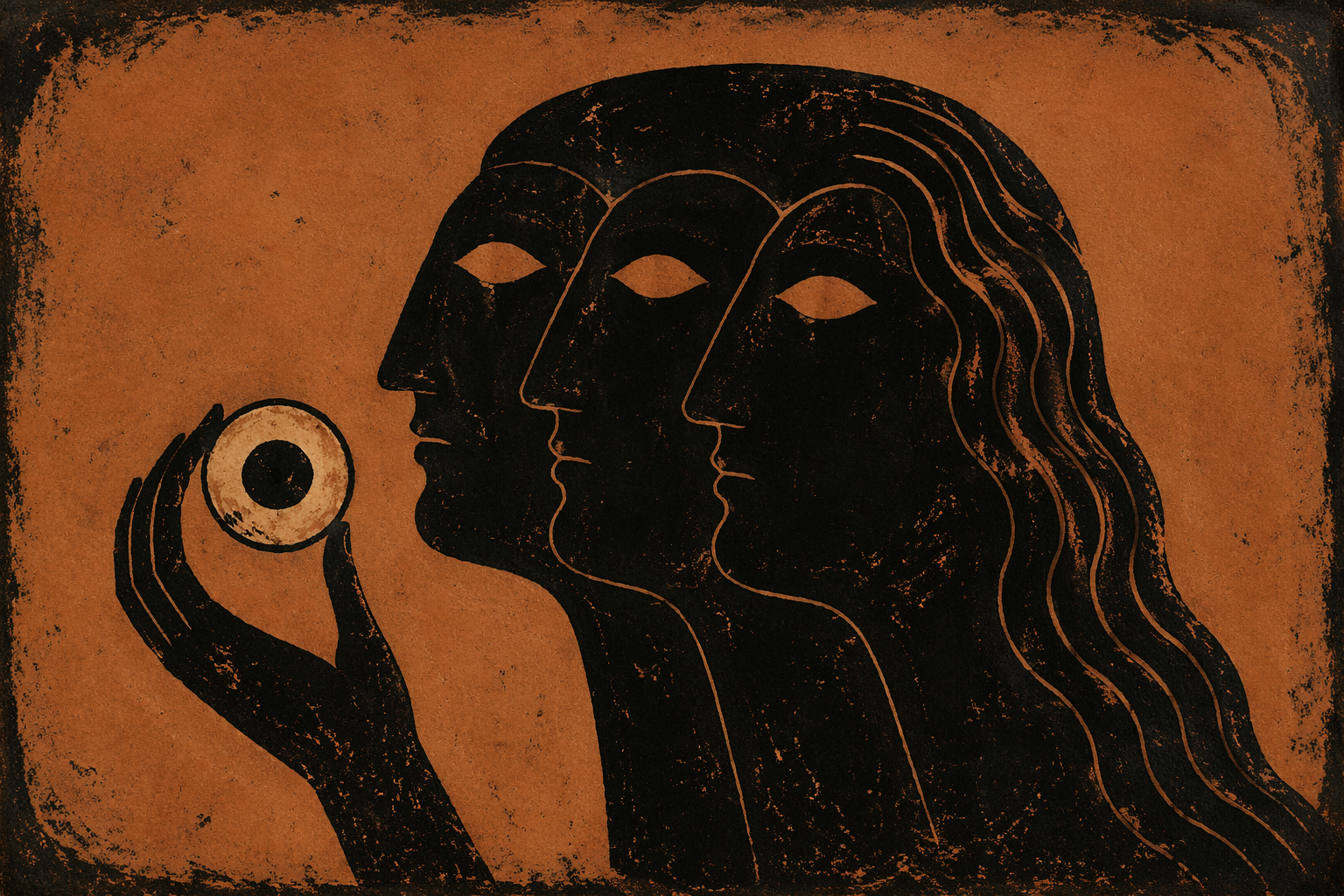

The Graeae — The Sharing of Sight
In this First World retelling, the Graeae are not merely strange old women at the edge of Perseus’s quest. They live under a harsher condition: one eye, one tooth, and no creature permitted to keep what all require. Their world depends not on possession, but on passage — the precise transfer of necessity from hand to hand. When Perseus interrupts that transfer, he does more than steal sight. He proves that trust itself can be taken in the interval between bodies.
There are conditions under which no creature is permitted to keep what it requires.
The Graeae belonged to such a condition from the beginning.
Not merely old. Not merely strange. They were born already under reduction, as though time had entered them before breath and taken from them in advance what other beings lose by degrees. Their hair bore the colour of ash not because ash had touched it, but because something in them had always lain after burning. Their skin held no season. Their mouths had the patient economy of bodies long instructed in scarcity. They did not possess enough between them to be called whole in the manner of other living things.
One eye. One tooth. Passage in place of ownership. Turn in place of claim.
They lived where the land had already withdrawn its welcome.
Rock, wind, salt. A ledge cut by old weather. A hollow where the air moved but did not soften. Nothing there admitted comfort. The stone had edges but no invitation. The sea below was not near enough to serve, only near enough to salt the air and mark each surface with slow abrasion. They inhabited that margin as if margins were the only places in which such a law could hold: not city, not sanctuary, not field, but a threshold where even the horizon seemed unwilling to complete itself.
They did not walk much.
Their world was organised not by distance but by sequence.
One held the eye.
One waited for it.
One waited behind that waiting.
Sight among them was not a faculty but an office. It passed hand to hand according to need, though need was too simple a word for what governed the exchange. Need can be spoken as if the body asks and receives. This was not that. The one with the eye did not merely see for herself. She stood for the others. She named the ground. She warned of the edge. She turned her face towards the sound of water and told its temper. She looked into the mouths of the wind and distinguished weather from approach. She watched the hand extended toward her and judged the moment of relinquishing.
Then the transfer.
That was the point upon which their world depended.
Not possession.
Not sight itself.
The handover.
A hand moved through dimness. Fingers opened. Another hand, practised by long privation, found what it had learned to find without seeing. The eye crossed the interval. For one instant it belonged to no one. In that instant all order narrowed to trust, timing, and the body’s memory of where another body would be.
Then receipt.
Socket.
Breath resettled.
The tooth moved likewise, though with less ceremony and a more immediate urgency. Hunger did not visit them as appetite visits the well-provided. It came as labour. Food had to be broken down by turn. The mouth that held the tooth worked while the others waited with the stillness of those to whom waiting is not delay but structure.
When the tooth passed, it crossed the same dark interval: hand, air, hand.
They had long since learned not to hurry the movement.
Speed was for creatures who could afford to lose things.
Their speech was spare and exact.
Not because they were wise. Not because age had refined them into utterance. Words simply cost too much when one lived by passing the necessary from one body to another. They did not narrate. They instructed.
Closer.
Hold.
Now.
Higher.
Edge.
Mouth.
Wait.
Continue reading: The Graeae — The Sharing of Sight at The House of Cadmus on Substack.
Also in House of Cadmus
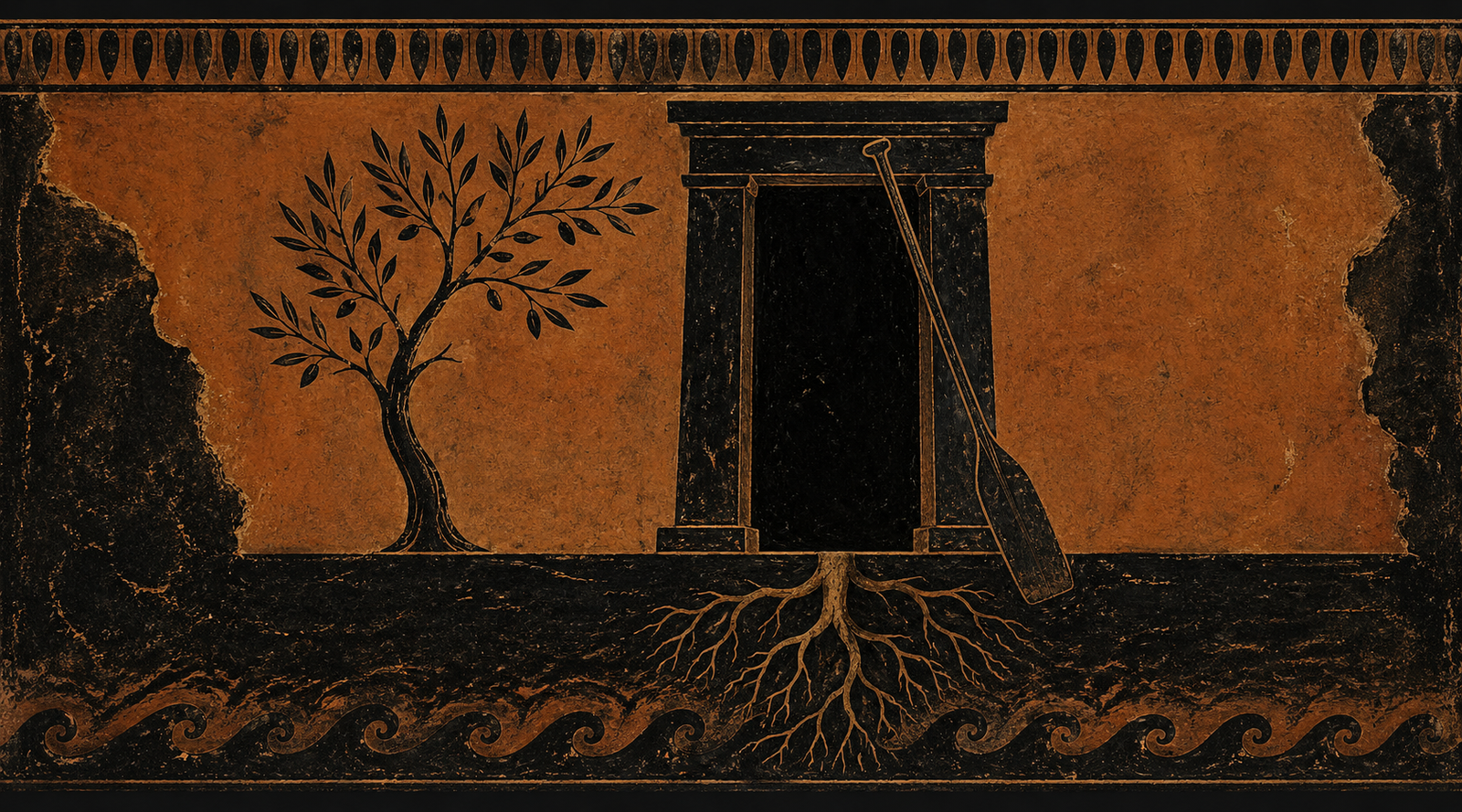

No Man Comes Home VI — The Oar That Could Not Belong
A grave Odyssey retelling from No Man Comes Home: Tiresias gives Odysseus a prophecy stranger than return itself. After Ithaca, after the suitors, after the bed and the bow, he must carry an oar inland until the sea’s own instrument is mistaken for something else.
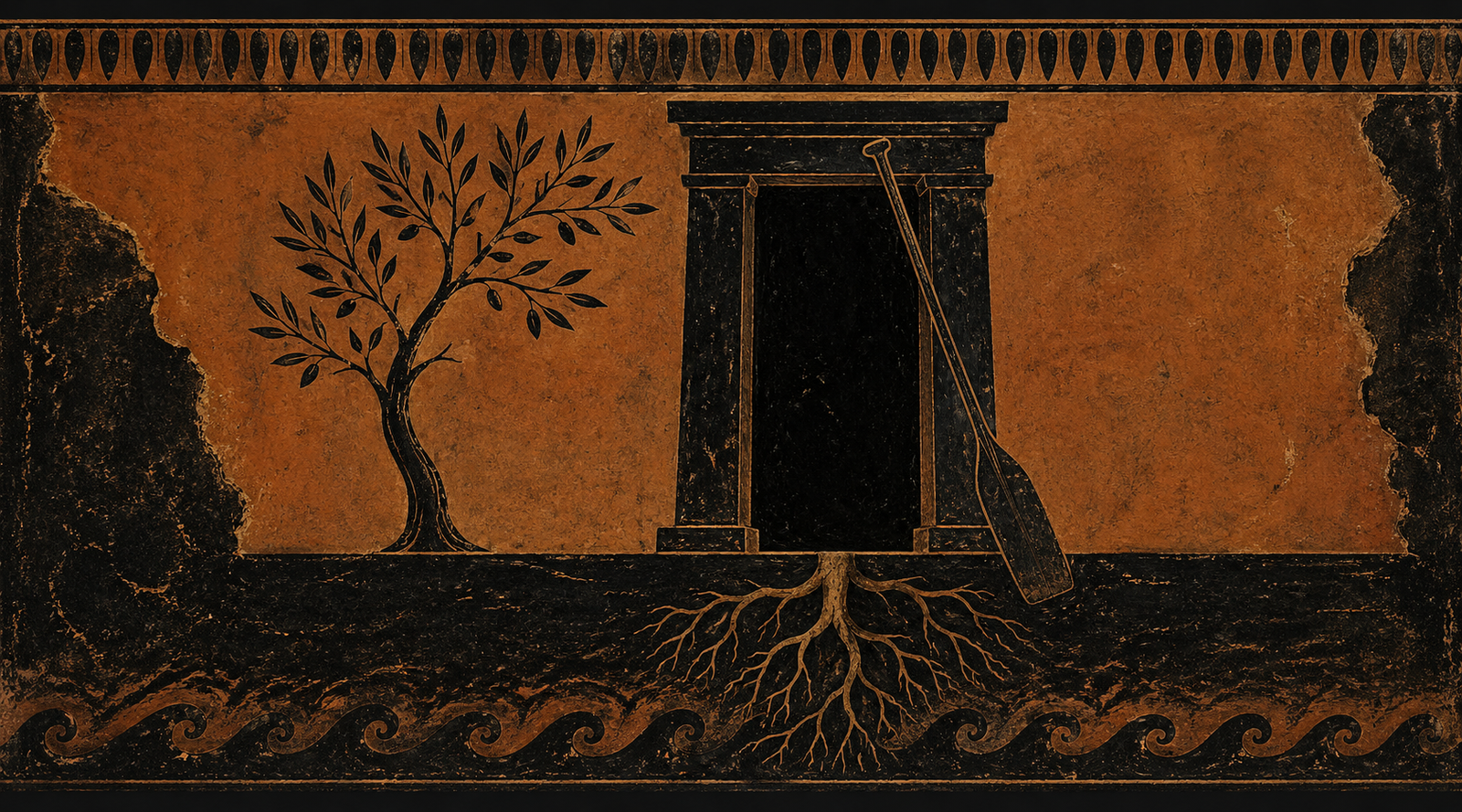

No Man Comes Home V — The Name Inside the Cave
In this fifth canto of No Man Comes Home, Odysseus enters the cave of Polyphemus with no need to be there. What follows is not only a famous Greek myth of cunning and escape, but a severe study of curiosity, leadership, hospitality, and the danger of needing one’s name to be known.
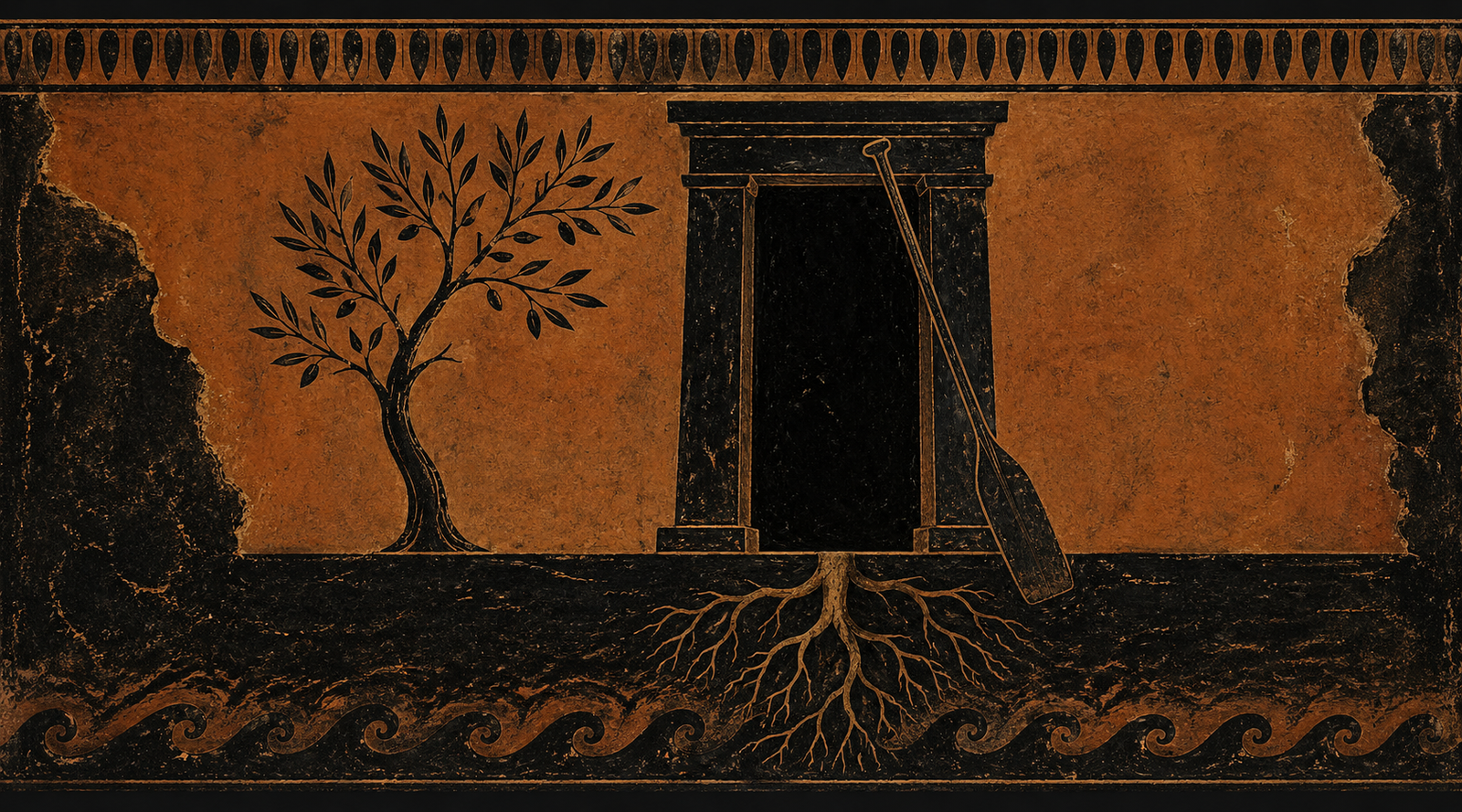

No Man Comes Home IV — The Stranger Washed Ashore
Odysseus has survived the sea, but survival is not yet return. Washed ashore on Scheria, naked and nameless, he must enter the human world again through restraint, supplication, Nausicaa’s courage, and the dangerous mercy of a house that does not yet know whom it has received.
Continue Reading
If this piece found something in you, you may wish to continue the journey elsewhere.
On The Lantern Chronicles, I gather writings from Angkor, myth and legend, contemplative essays, and poetry — works shaped by silence, beauty, wonder, memory, and the deeper questions that follow us through the world.
It is a place for stone and story, reflection and vow, shadow and revelation.
You would be most welcome there.