
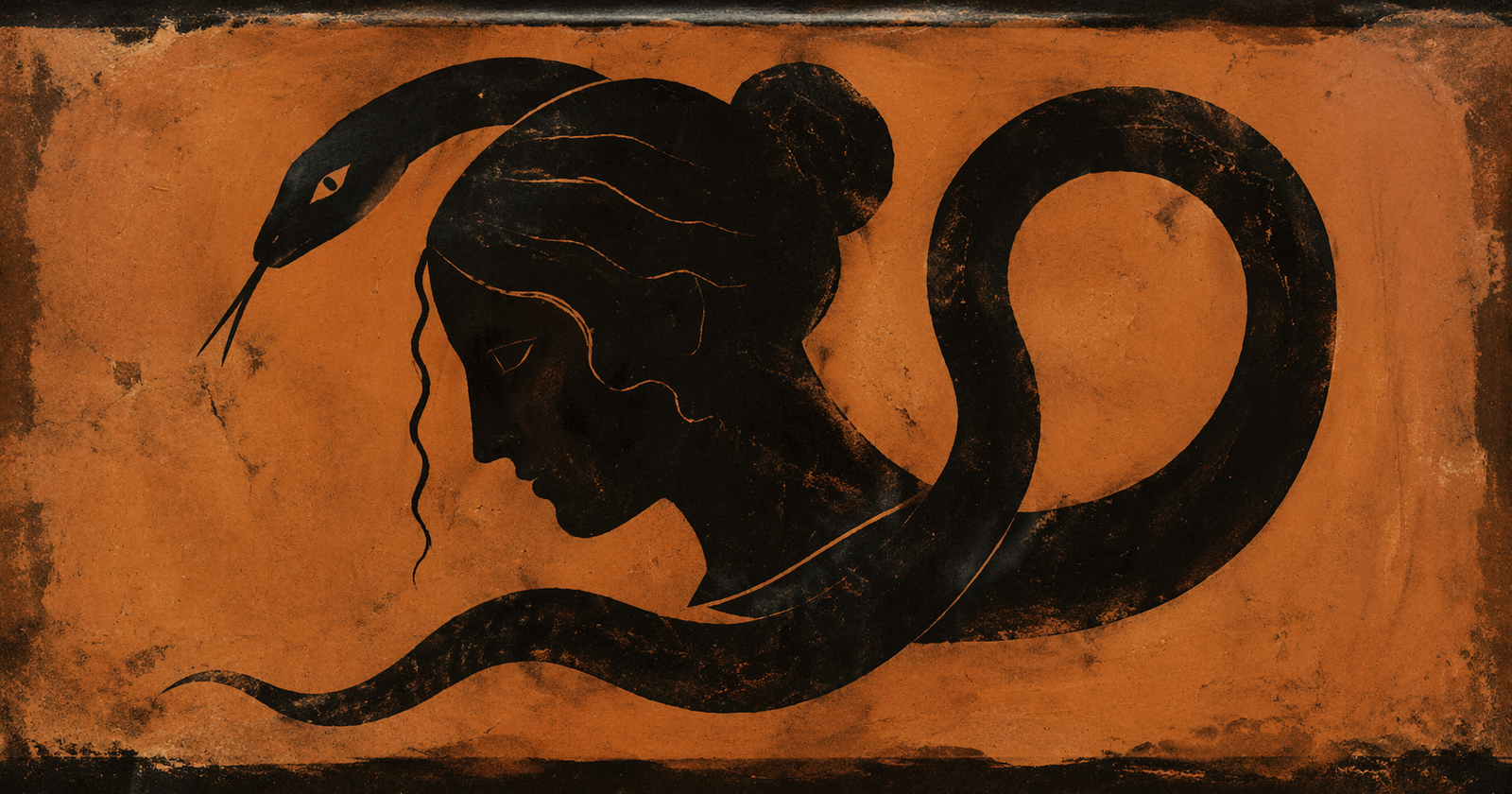

Prometheus — The Fire Under Penalty
In this First World retelling, Prometheus does not steal fire as a simple benefactor of mankind, nor as a rebel seeking glory in defiance. He sees human incompletion hardening into order. He understands that to leave the boundary standing would also be an act. Fire crosses into mortal hands, but not innocently. What is withheld may be taken; what is taken may alter the world; and the taking inscribes its cost into flesh.
Before men had fire, night was not an interval but a dominion.
Darkness did not fall and lift. It took hold. It entered the hollows where they slept, the seams of hide, the mouths of caves, the joints of the hand. Rain came into their shelters and stayed there. Wind found them through stone. They ate what yielded. They tore at roots, cracked what bone they could, crouched where rock broke weather, and waited for dawn not because dawn promised anything, but because it lessened what night had imposed.
They were not yet the thing they would later call themselves.
A beast is fitted to the terms of its life. It comes into the world already armed with the measure by which it will endure it: fur, claw, speed, burrow, fang, wing, instinct, concealment. Men had the hand that could become many tools and no means yet to teach it. They had the mouth that could gather breath for speech and no craft by which speech might harden into dwelling, custom, city, law. They had memory enough to fear the return of cold and no mastery by which to answer it.
When lightning struck and a tree burned on a far ridge, they watched the brightness as one watches something belonging to another order. When the trunk at last collapsed into black wood and pale ash, they were left with what they had always had before: the old exposure, the old dark, the old incompletion.
Prometheus saw this, and did not find it noble.
He did not look upon men and discover in their lack some rough dignity with which poets later comforted themselves. He found them unfinished. That was worse. Need can be borne. Incompletion is an affront when the means of completion exists elsewhere under guard.
He was not the strongest among the deathless powers, nor did he trust strength much. Strength announces itself too early and mistakes its own pressure for permanence. What endures longer is sequence: the order by which one act enters another, by which power ripens into decree, by which an arrangement hardens and begins to call itself law. Prometheus saw by sequence. Where others saw an event, he saw its continuation. Where others praised force, he watched the shape force would take once it had seated itself.
It was by such sight that Zeus had risen.
Men remembered later only the throne, the thunder, the settled hierarchy of heaven, but not long before the thing had still been in dispute. Zeus had not won because he was strongest. He had won because the old order had become legible at the point of its weakness, and because cunning had served where force alone would have broken itself. Prometheus had known that before Zeus knew it. He had understood that the future belongs not always to the greater blow, but to the better reading of where blows lead.
It was not affection that joined him once to Zeus, but recognition.
That was why he recognised the danger sooner.
For once power has installed itself, it begins to forget the intelligence by which it came there. It calls victory justice. It calls arrangement necessity. It calls its own preferences order. Then what was once strategy becomes sovereignty, and sovereignty, if unopposed, begins to mistake withholding for right.
The first sign of this had appeared not in the theft of fire, but at the table.
At Mekone the ox was divided.
The body lay open under daylight, red within, pale where bone showed through, the bright fat lifted aside, the whole grammar of killing exposed: what can be kept, what must be yielded, what can be disguised, what can be named. Men stood near and learned, though they did not yet know they were learning, that life would proceed by portions. Nothing entire would remain in their hands. The world would be lived through division, allotment, sacrifice, claim.
Prometheus touched the carcass and saw at once that the division mattered beyond the meal. If the terms of exchange were fixed wrongly here, there would be no later correction gentle enough to matter. Once a hierarchy learns its own appetite, it seldom relaxes.
So he made two offerings.
In one place he laid the useful flesh and hid it under what did not call to desire. In the other he heaped the white bones and wrapped them in shining fat until loss appeared splendid. He made display contend with substance. He made appearance stand where judgement ought to stand.
Then he invited Zeus to choose.
Whether Zeus chose in ignorance or in knowledge, later men never settled, because they could not bear the truth that governs such moments: both are true enough for the living. Power may be deceived. Power may also see the deceit and accept it only to punish more deeply later.
Zeus laid hand to the bright fraud.
The bones were his.
From that choice came the order of sacrifice: smoke and fat for the gods, flesh retained below for men. But from that same choice came memory in Zeus, and memory in a ruler is unlike memory in the afflicted. Men remember through wound and weather. Zeus remembered through reprisal.
He hid fire.
Continue reading: Prometheus — The Fire Under Penalty at The House of Cadmus on Substack.
Also in House of Cadmus

No Man Comes Home X — The Hall Reveals Itself
Odysseus returns to Ithaca disguised as a beggar, but the first creature to recognise him is the neglected dog Argos. In this severe literary retelling of The Odyssey, the king enters his own hall as need, and every act of hospitality, contempt and blindness becomes part of the house’s final testimony.

No Man Comes Home IX — The Beggar at His Own Door
Odysseus reaches Ithaca at last, but return does not grant him recognition, reunion, or peace. Disguised by Athena as a beggar, he must enter his own kingdom without name or power and allow the house to reveal what it has become. The ninth canto of No Man Comes Home turns homecoming into a test of loyalty, restraint, and concealed violence.

The Objects That Know Him
Name, oar, wax, scar, bow, bed, door: ordinary things carry a quieter authority beneath the marvels of The Odyssey. This House of Cadmus essay considers how objects recognise Odysseus, judge the concealments that preserved him, and make return more difficult than merely reaching Ithaca.
Continue Reading
If this piece found something in you, you may wish to continue the journey elsewhere.
On The Lantern Chronicles, I gather writings from Angkor, myth and legend, contemplative essays, and poetry — works shaped by silence, beauty, wonder, memory, and the deeper questions that follow us through the world.
It is a place for stone and story, reflection and vow, shadow and revelation.
You would be most welcome there.