

The Face That Looks Four Ways
The Bayon and the Problem of Sacred Identity
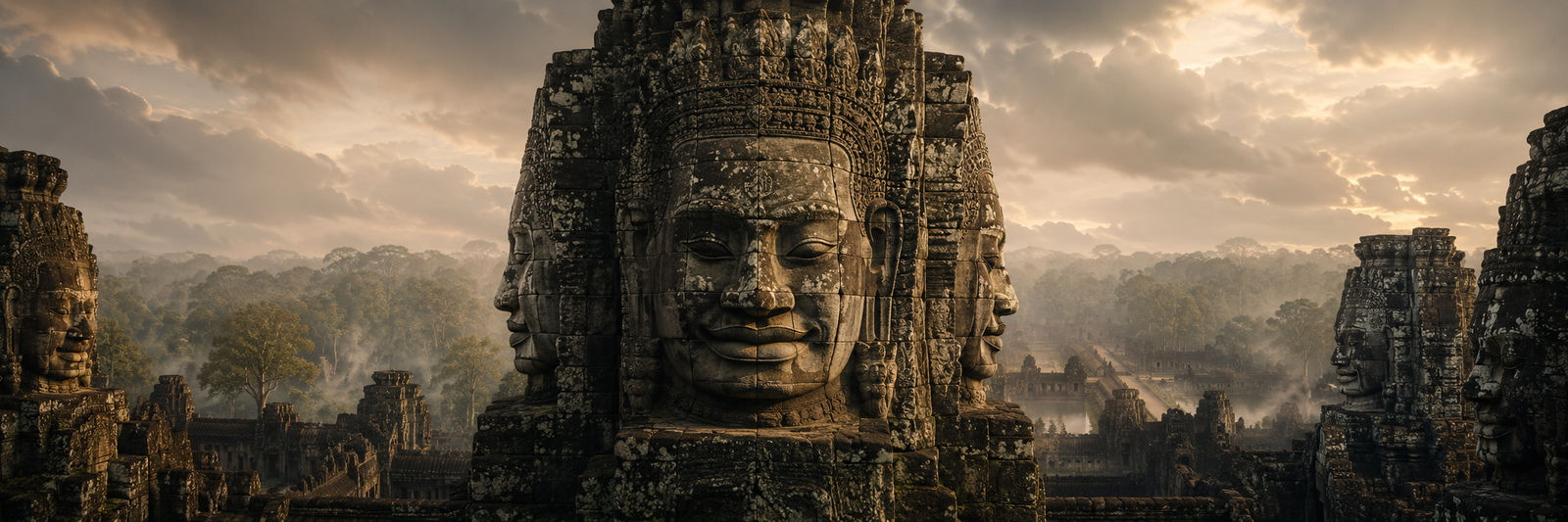
At the Bayon, the question does not begin with scholarship. It begins with being looked at.
One climbs into the upper terraces of the temple and finds the air changed by faces. They are above, beside, behind. They look across broken galleries and into empty space. They turn towards the gates of Angkor Thom, towards roads, forest, rain, armies no longer moving, markets no longer speaking, kings no longer alive.
They are not hidden in sanctuaries. They are not waiting in darkness as cult images do. They are lifted into the architecture itself, repeated on towers, made part of the skyline.
And yet the simplest question remains unanswered.
Whose face is this?
For more than a century, the colossal faces of the Bayon have been among the great problems of Angkorian interpretation. They have been called Brahma. They have been called Lokeshvara. They have been called Jayavarman VII. They have been called Vajrasattva. They have been treated as gods, bodhisattvas, royal portraits, tantric Buddhas, cosmic guardians, territorial powers, and political theology in stone.
The difficulty is not that the faces say nothing. The difficulty is that they say too much at once.
They are arranged like a four-faced deity. They belong to a Buddhist state temple. They resemble the image-world of Jayavarman VII. They bear the composure of sacred power. They look less like a single person than a principle that has chosen a human expression.
Their mystery may not be a failure of evidence. It may be part of their function.
To ask what the Bayon faces “are” is therefore already to risk asking the question too narrowly. Angkor did not always divide categories as modern interpretation does. King, god, Buddha, mountain, city, ancestor, bodhisattva, and protective power could be made to touch one another. The Bayon stands precisely at that point of contact.
It is not merely a temple with faces.
It is a city-centre made conscious.
The Exactness of the Mystery
Before the theories can be weighed, the uncertainty itself must be understood.
The Bayon is not mysterious only because visitors lack information. It remains mysterious even for those who have spent their lives studying inscriptions, reliefs, architecture, iconography, ritual, and Khmer religious history. Scholarship has not dissolved the problem of the faces. At its best, it has made the problem more exact.
This matters. A vague mystery can be romanticised. The Bayon’s mystery is not vague. It is made of precise difficulties.
The temple was built under Jayavarman VII at the centre of Angkor Thom, the great walled city raised after a period of political violence, Cham conflict, and royal restoration. It was not a minor shrine or local monument. It was the state temple of a king who reorganised Angkor’s religious and political landscape around Buddhism.
Yet the Bayon was also altered over time. Later religious changes affected its imagery. Hindu, Buddhist, royal, ancestral, and local elements coexist within and around it. The temple we see now is not a single sentence preserved without revision. It is a layered object. It remembers more than one religious and political moment.
The central fact, however, remains decisive: the Bayon was originally Buddhist. Its principal icon was a monumental Buddha seated beneath the naga Muchalinda. This does not by itself identify the tower faces, but it prevents any interpretation that treats the Bayon’s first intention as simply Hindu.
The faces themselves, however, remain strangely resistant. They do not carry an inscription naming them. They do not show every conventional attribute of Lokeshvara. They are not ordinary portraits. They are not conventional Buddhas. They are not simply Brahma, despite their fourfold arrangement. They are both image and structure, both face and tower, both deity and architectural principle.
This is why the debate has endured.
Each theory explains something.
None explains everything.
Brahma: The Four-Faced God
The oldest and most immediate interpretation identifies the faces as Brahma, the four-faced Hindu creator god.
The strength of this theory is obvious. Many Bayon towers carry faces looking outward towards the cardinal directions. Brahma is the best-known four-faced deity in the Indian religious imagination. If one sees four divine faces arranged around a tower, Brahma is a natural first answer.
This was not merely a naive error imposed by early Western visitors. It belongs to a wider history of reception. Early visitors were told that the faces were Prohm, the Khmer form of Brahma. Regional traditions of Prohm or Phrom gates also make this identification more than an accidental misunderstanding. Whatever the Bayon originally meant, the Brahma reading seems to have mattered in later Cambodian and regional memory.
That matters because a temple does not possess only one life. It has its founding intention, its later transformations, its local names, its scholarly rediscoveries, and its continuing power in the imagination of those who live near it. Brahma may not explain the Bayon’s first theological programme, but the tradition cannot simply be brushed aside. It may preserve part of the temple’s later reception.
Even so, the weaknesses are substantial.
Brahma does not fit the original Buddhist programme of the Bayon. The temple belongs to the religious world of Jayavarman VII, whose great foundations were shaped by Mahayana Buddhist kingship. Its central cult image was a naga-protected Buddha, not Brahma. If the face towers are read as Brahma, one must explain why a Buddhist state temple would place Brahma’s image in such overwhelming dominance above its sacred centre.
There is also the problem of status. Brahma appears in Khmer religious art, but he was not usually the principal figure of royal temple identity. Khmer kings drew deeply on Hindu cosmology, and Brahma had a recognised place within that world, but he did not carry the same central force as Shiva, Vishnu, the Buddha, or the bodhisattvas associated with Jayavarman VII’s Buddhist programme.
Finally, four-directional vision is not exclusive to Brahma. It can indicate cosmic authority, universal awareness, royal supervision, territorial protection, or the reach of compassion across space.
The Brahma theory therefore names something real, but probably not the temple’s first intention. It explains the geometry more readily than it explains the original soul.
Lokeshvara: The Lord Who Looks
The most influential scholarly interpretation identifies the faces as Lokeshvara, or Avalokiteshvara, the Bodhisattva of Compassion.
This theory has great force because it fits the religious atmosphere of Jayavarman VII’s reign. Jayavarman was not merely a king who happened to build Buddhist temples. His rule seems to have imagined kingship itself in Buddhist terms: compassion, protection, healing, roads, rest houses, hospitals, and the care of the realm. His inscriptions speak in a language of suffering and remedy, as though the ruler’s duty were not only to command but to relieve.
Lokeshvara belongs naturally to such a world. He is the bodhisattva who looks upon suffering and responds. If any figure could be multiplied across the towers of a royal city, looking in all directions, it would be this one. The Bayon faces become, in this reading, the face of compassion extended across the kingdom.
The case becomes stronger when the Bayon is considered beside Jayavarman VII’s other great Buddhist foundations. At Ta Prohm, the principal image was associated with Prajnaparamita, the Perfection of Wisdom, and with the king’s mother. At Preah Khan, the principal image was Lokeshvara and was associated with the king’s father.
This is crucial, because it loosens a modern opposition that may not belong to Angkor. We are tempted to ask whether an image is a deity or a portrait. But the Preah Khan evidence suggests something subtler. A sacred image could be Lokeshvara, could bear a royal or ancestral name, could be associated with the king’s father, and could function as a material manifestation without needing to be a literal portrait in the modern sense.
That is one of the keys to the Bayon.
The Angkorian imagination did not need to choose between likeness and divinity as sharply as we do. A sacred image could hold deity, memory, royal lineage, and mystical association together.
The Bayon faces may work in precisely this way. They need not be “only Lokeshvara” or “only Jayavarman VII.” They may be royal Buddhist presence made visible through the form of compassionate divinity.
This explains much.
It explains the serenity of the faces. It explains their outward gaze. It explains their repetition. It explains why a Buddhist state temple would be crowned not only by a central Buddha but by an omnipresent compassionate watcher. It also explains why the faces feel less like warriors or judges than presences of enormous stillness.
But the Lokeshvara theory has a serious difficulty: iconography.
Avalokiteshvara is often identified by the small figure of the Buddha Amitabha set in his hair or crown. This is a major identifying sign. The Bayon faces do not clearly show it. Their crowns and ornaments are elaborate, but the decisive Amitabha marker is absent. Nor do the faces always carry the lowered meditative gaze one might expect from a conventional bodhisattva image. Many of them look outward with open, commanding eyes.
This does not destroy the Lokeshvara theory. Monumental architectural images can simplify, transform, or absorb iconographic details. Khmer religious art was not obliged to obey later museum categories. But it does prevent a simple conclusion.
The faces behave like Lokeshvara, but they do not wear all his signs.
For that reason, the Lokeshvara interpretation remains one of the strongest and most necessary readings, but it must be held with care. The faces are not ordinary statues of Avalokiteshvara enlarged onto towers. They are something more architectural, more royal, more fused.
They are not merely the Bodhisattva of Compassion.
They are compassion given a state body.
The Temple Without Faces: Preah Khan and the Limits of the Lokeshvara Answer
There is, however, one difficulty that any simple Lokeshvara theory must face.
Preah Khan.
If the Bayon faces are plainly and only Lokeshvara, then Preah Khan becomes a riddle beside the riddle. For Preah Khan was the great temple of Jayavarman VII’s father, Dharanindravarman, honoured in the form of Lokeshvara. Its foundation inscription tells us what the Bayon does not. It gives us a named image, a dedication, a familial meaning, and a royal theology made explicit. Here the bodhisattva is not inferred from a face in the sky. He is named.
And yet Preah Khan has no face towers.
This absence matters.
It shows that Lokeshvara alone does not explain the architectural phenomenon of the faces. If a temple could be profoundly dedicated to Lokeshvara without producing face towers, then the Bayon faces cannot be treated simply as enlarged Lokeshvara icons. Something else has happened at the Bayon. The bodhisattva has not merely been represented. He has been converted into an architectural condition.
Preah Khan is a temple of memory, filial piety, victory, institution, and sacred enclosure. Its symbolic force is dispersed through its stele, its shrines, its processional axes, its monastic functions, and its powerful perimeter guardians. It does not need to make the sky look back.
The Bayon does.
This distinction sharpens rather than weakens the Lokeshvara theory. It suggests that the Bayon faces may belong to Lokeshvara’s world, but not to Lokeshvara alone. They are what happens when compassionate Buddhist presence is made into the sovereign centre of a royal city. At Preah Khan, Lokeshvara receives the king’s father. At the Bayon, something more comprehensive occurs: kingship, compassion, cosmic order, and political vision are fused into a single face, multiplied above Angkor Thom.
This also helps explain why Jayavarman VII’s temples must not be read as interchangeable expressions of one idea. Ta Prohm, Preah Khan, Neak Pean, Banteay Chmar, and the Bayon do not merely repeat a formula. They translate related religious concerns into different architectural languages.
Ta Prohm speaks through wisdom and the mother.
Preah Khan speaks through Lokeshvara and the father, through sacred victory, monastic order, and guarded enclosure.
Neak Pean speaks through healing water.
Banteay Chmar speaks through remote imperial memory and Buddhist protection.
The Bayon speaks through the centre itself.
Preah Khan therefore teaches caution. The name Lokeshvara can carry immense weight in Jayavarman VII’s world, but it does not automatically explain every form that Buddhist kingship takes. The face towers are not the inevitable sign of Lokeshvara. They are a particular invention, reserved for a particular kind of presence.
They are not merely compassion.
They are compassion enthroned as empire.
Jayavarman VII: The King as Face
Another powerful theory sees the faces as idealised portraits of Jayavarman VII himself.
This is not difficult to understand. The Bayon is his temple, placed at the centre of his capital. Its towers rise above the royal city he built. Its faces look towards the roads and gates through which the kingdom entered and was entered. No other king is so strongly associated with the monument’s original meaning.
There is also a physiognomic argument. The faces resemble known portrait images associated with Jayavarman VII: broad cheeks, full lips, heavy eyelids, a calm but powerful mouth, a face that seems inwardly composed rather than theatrically divine. The resemblance is not photographic, but Angkorian royal portraiture was never photographic. It sought ideal presence, not documentary likeness.
The king’s face, in this theory, becomes an instrument of rule. It watches the four directions. It blesses and supervises. It makes royal power visible even where the king is absent. The face becomes political architecture.
There is something compelling in this. The Bayon does not feel like a temple of private devotion. It feels like a structure through which the whole city is governed. The faces do not merely receive worship. They radiate authority.
But a pure portrait theory is too small.
The Bayon faces are not simply repeated royal busts. They are too elevated, too cosmic, too incorporated into the symbolic mountain of the temple. Their repetition suggests more than commemoration. It suggests a transpersonal power that uses the royal face as one of its possible forms.
Nor do the tower faces preserve the kinds of individual detail that would make them straightforward portraits. They are not intimate studies of a man’s ageing, biography, fatigue, or temperament. They are royal, but more than personal. They are humanised divinity or divinised kingship, not simple likeness.
The best version of the Jayavarman theory is therefore not that the faces are “only the king.” It is that Jayavarman VII’s image has entered the sacred system. The king is not represented apart from divinity. He is represented through it.
Here again, the Preah Khan evidence is useful. If Lokeshvara could be consecrated as an image associated with the king’s father without being merely a portrait of the father, then the Bayon faces could likewise bear royal resonance without becoming merely likenesses of Jayavarman VII.
The modern question asks: deity or king?
The Bayon’s answer is less binary. The face may be royal without being merely personal. It may be divine without being detached from the king. It may carry the authority of Jayavarman VII not by recording his individual features, but by turning his kingship into sacred visibility.
What looks at us from the towers is not biography.
It is Buddhist kingship made visible.
Vajrasattva: The Tantric Pressure
The most challenging recent interpretation identifies the tower faces not as Lokeshvara, but as Vajrasattva, a supreme tantric Buddhist figure.
This theory should not be treated as a decorative late speculation. It is a serious pressure placed on the familiar guidebook formula: Lokeshvara facing all ways in the likeness of Jayavarman VII. It arises because that formula, while powerful, does not explain everything.
The faces are iconographically minimal. They lack the clear Amitabha sign of Lokeshvara. Their eyes are often open, direct, and commanding. Their regalia suggest not only compassion but royal cosmic force. The whole Bayon may belong to a more complex Buddhist world than a simple cult of compassion.
The Vajrasattva theory takes that complexity seriously.
It asks whether Jayavarman VII’s Buddhism may have evolved over time: from a Mahayana Buddhist system centred on wisdom, compassion, and royal healing, towards a more explicitly tantric, mandalic, and sovereign form of Buddhism. In such a world, the Bayon would not merely be a temple of compassionate protection. It would be a cosmic Buddhist diagram, a state mandala, a structure in which the supreme Buddhist presence fills space in every direction.
This reading also suits the strangeness of the face towers. They are not ordinary cult images. They are not placed inside sanctuaries as statues usually are. They rise from the temple’s superstructure. They turn the whole building into a divine body. Their repetition is not narrative but emanational. One face becomes many, and the many are ordered in space.
The Vajrasattva theory therefore answers real problems. It explains the open eyes. It explains the regalia. It explains the minimal iconography. It takes seriously the late-Bayon possibility of tantric Buddhist thought. It also gives intellectual weight to the sense that the Bayon is not just decorated architecture but a three-dimensional sacred diagram.
Its weakness is not trivial, however.
The evidence does not compel universal agreement. The theory depends on a complex reconstruction of Jayavarman VII’s late religious world. It must connect inscriptions, bronzes, tantric deities, architectural phasing, face towers, royal ideology, and international Buddhist history into a single interpretation. That may be illuminating. It may even be right in significant ways. But it is not a settled consensus.
This is where the Vajrasattva theory is most valuable for the essay. It prevents a premature conclusion. It teaches us that “Lokeshvara” may be too simple if spoken as a final answer. It reminds us that Jayavarman VII’s Buddhism was likely not static, and that the Bayon may represent a late, dense, sovereign, tantric form of Buddhist kingship.
The faces may participate in the world of Lokeshvara.
They may also press beyond it.
The Problem with Choosing One Name
The debate often assumes that the task is to choose one identity and reject the others. Brahma or Lokeshvara. King or bodhisattva. Portrait or deity. Compassion or power. Mahayana or tantric Buddhism.
But the Bayon may not have worked like that.
A modern label wants the face to be one thing. Angkorian sacred kingship may have wanted it to be a place where several things became one another.
This is the deeper possibility. The face may have been deliberately multivalent. It may have been made to carry Buddhist, royal, cosmic, ancestral, territorial, and perhaps tantric meanings simultaneously. Its power may depend on the fact that it does not collapse into a single identity.
Seen this way, each theory preserves part of the truth. The Brahma theory recognises the four-directional structure and preserves part of the temple’s later reception. The Lokeshvara theory recognises the Buddhist compassion at the heart of Jayavarman VII’s royal ideology. Preah Khan recognises the limit of that theory: Lokeshvara could be central to Jayavarman VII’s religious world without producing face towers. The Jayavarman theory recognises the physiognomic and political force of the monument. The Vajrasattva theory recognises the possibility that the Bayon belongs to a more esoteric and mandalic form of Buddhist sovereignty.
The error is not in seeing any of these.
The error is in insisting that one alone must cancel all the others.
The Bayon stands at the centre of Angkor Thom. Roads approach it from the gates. The causeways of the city enact the Churning of the Sea of Milk. The temple rises as a mountain. Its central Buddha sat beneath the naga. Its galleries carry battles, markets, processions, deities, soldiers, fishermen, animals, and ordinary people. It gathers the world.
Why should its faces be less comprehensive than the temple itself?
The safest conclusion is therefore not a single name, but a hierarchy of likelihoods. The faces are almost certainly part of a Buddhist royal programme. They probably participate in the world of Lokeshvara: compassion, looking, rescue, protection, and the association of Buddhist divinity with the king’s sacred family and royal legitimacy. But Preah Khan prevents us from stopping there. A temple can be dedicated to Lokeshvara without face towers. Therefore the Bayon faces are not simply Lokeshvara images. They are a special architectural invention.
They also probably bear deliberate royal resonance. Whether or not they are portraits in any narrow sense, they belong to the visual and political world of Jayavarman VII. The king’s presence is not absent from them.
They may also preserve, express, or anticipate a more tantric conception of supreme Buddhist presence, such as Vajrasattva. This theory is too important to ignore, especially because it answers real iconographic and theological difficulties.
They are unlikely to have been originally conceived simply as Brahma, though Brahma remains important for later reception and for understanding how four-directional sacred vision was remembered. They are too cosmic to be only portraits of the king.
The Bayon faces are not best understood as portraits of a king disguised as a god, nor gods accidentally resembling a king. They are the image of Buddhist sovereignty made visible: compassion given the authority of empire, authority given the face of compassion, and perhaps both absorbed into a still more expansive vision of supreme Buddhist presence.
This does not mean the faces are vague. It means their precision belongs to another order.
They are not uncertain because Angkor failed to decide.
They are powerful because Angkor could hold together what later interpretation separates.
A king may rule.
A bodhisattva may look with compassion.
A Buddha may sanctify the centre.
A tantric deity may fill space with emanations.
A mountain may stabilise the world.
A city may be drawn into sacred order.
At the Bayon, these are not separate statements.
They are one face, looking four ways.
The Face That Remains
Perhaps this is why the faces still disturb interpretation. They do not behave like evidence alone. They behave like presence.
The scholar asks for attributes. The historian asks for context. The archaeologist asks for phases. The iconographer asks for identifying marks. The visitor simply feels the gaze.
But the visitor and the scholar are not as far apart as they seem. Both stand before a temple that refuses to simplify itself. Both discover that the Bayon’s mystery is not dissolved by knowledge. It becomes more exact.
The faces do not answer by narrowing themselves. They answer by remaining larger than the question. They do not say only Brahma, only Lokeshvara, only Jayavarman, only Vajrasattva. They look east, west, north, and south. They look over gates and roads, over the old wound of invasion and the royal dream of restoration, over the mingling of daily life and cosmic order.
And beside them, in silence, stands Preah Khan: the temple of the father, the temple of Lokeshvara, the temple without face towers. Its absence clarifies the Bayon. It tells us that the faces are not the automatic sign of a deity, but the deliberate sign of a particular kind of Buddhist kingship.
Preah Khan keeps memory within the enclosure.
The Bayon releases presence into the sky.
The faces are serene, but not passive. They smile, but not lightly. Their calm is the calm of something that has already absorbed contradiction. Human and divine. Buddhist and royal. Compassionate and commanding. Still and watchful. Personal and impersonal.
They are not the face of one man alone.
They are not the mask of one god alone.
They are the face of a world in which power wished to appear as compassion, and compassion was given the scale of empire.
That may be the closest answer the Bayon allows.
And perhaps it is enough.
—
Receive the next work
Subscribe free to receive new work from the Lucas Varro Library by email.
More from the Library


See Also
A concise and impartial dictionary of absence, promises, quarrels, ordinary objects, and the troublesome instability of words.

The City of Service
The temple we inherit is a building from which almost all necessity has been removed. Nothing must be brought for it to continue being what we call a temple. The sanctuary asks nothing of us. Stone is good at this kind of independence.
A living temple was otherwise.
Water had to come in. So did grain, cloth, oil, aromatic substances, fuel. The things required for worship arrived because someone carried them across a threshold.

Houses of Wood, Light, and Smoke
Some of Angkor’s most intimate ruins do not rise above the ground at all. They are postholes, low mounds, hearths and ponds: durable traces of a domestic city built largely from things that decay. To restore that city is to see Angkor not only as stone, but as wood, smoke, water, repair, and people living within calling distance.