
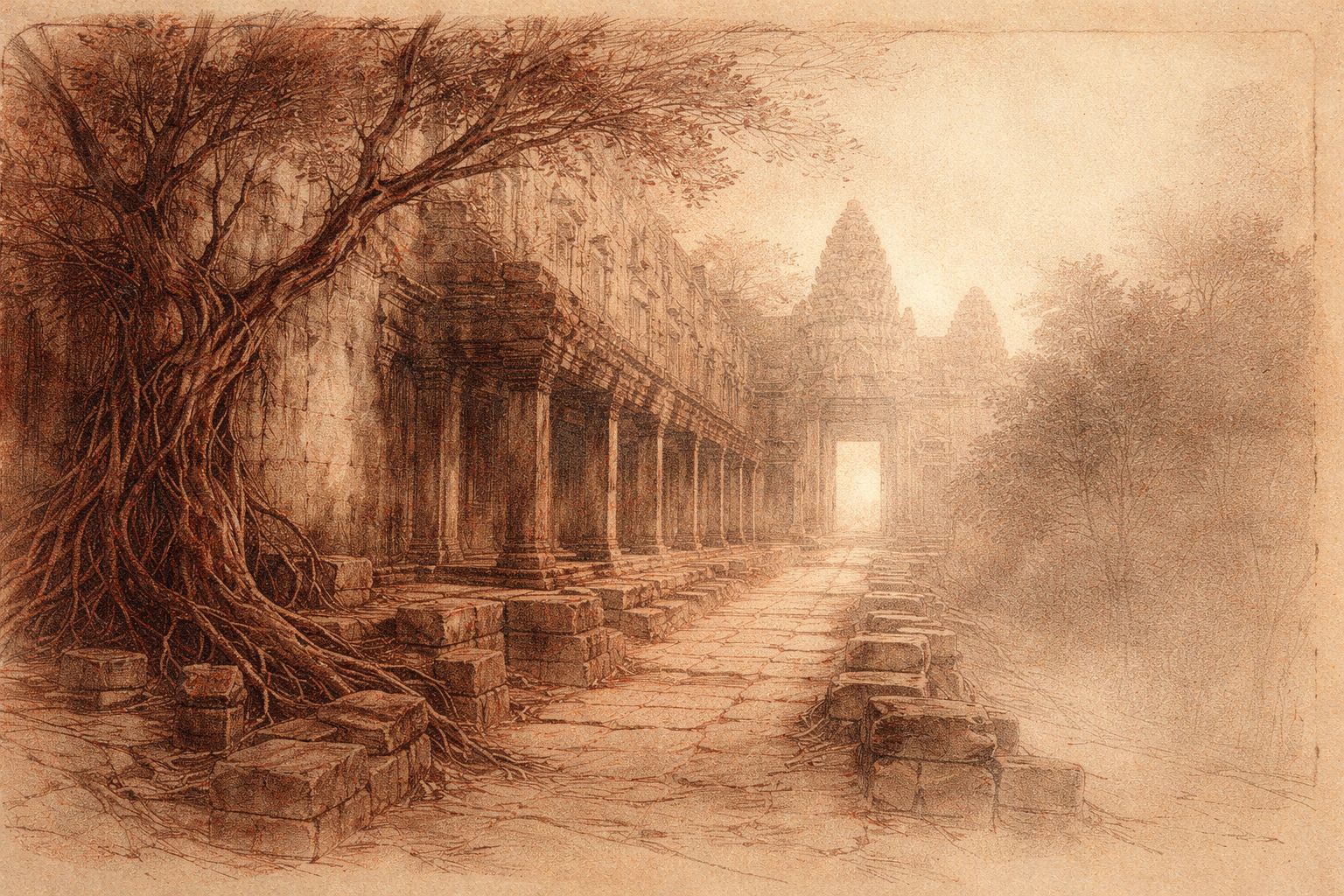

On Seeing Angkor
Most people believe they have seen Angkor the moment they arrive.
The towers rise above the trees. The long causeway stretches across the water. The view resembles the photographs they have carried with them for years. Cameras lift. The familiar scene is confirmed.
Recognition is immediate.
But recognition is not the same as seeing.
Recognition moves quickly. It identifies what it already expects. The mind compares the place before it with images carried from elsewhere—guidebooks, travel films, postcards—and decides that the temple has been understood.
Seeing moves more slowly.
Visitors rarely arrive empty-handed. Long before the journey begins, Angkor has already taken shape in the imagination. We know the towers rise above the jungle. We know the galleries are filled with carvings. We expect grandeur, mystery, antiquity.
Expectation narrows attention.
A visitor who carries a finished picture of Angkor Wat will search for the place where that picture can be repeated. The temple becomes a destination rather than an encounter. Once the expected view has been recognised, the mind relaxes. The place has been “seen.”
Yet the temple remains largely unseen.
Angkor is too vast, too intricate, too patient to reveal itself in a single glance. The galleries extend for hundreds of metres. Corridors open into courtyards, and courtyards into deeper enclosures. Carvings gather along the walls in endless procession.
The temple does not appear all at once.
It unfolds.
True seeing begins when the pace of the body changes. The visitor who hurries through the galleries gathers impressions but little understanding. The pilgrim who slows down allows attention to widen.
Standing still for a moment, one begins to notice what first escaped the eye. A devata face emerges from shadow. The worn centre of a step records the passage of countless feet. A faint breeze moves through the corridor and disappears again.
These things were present from the beginning.
They simply required time to appear.
Seeing is not a matter of looking harder. It is a matter of allowing perception to settle. When the mind stops searching for what it expects to find, attention begins to move more freely. What seemed decorative becomes intricate. What seemed familiar becomes strange.
Light plays its part in this slow revelation. A carving that appears flat at first glance gathers depth when the sun shifts across the stone. Figures separate from one another. Gestures become visible. Expressions begin to hover within the worn sandstone.
The wall that seemed ornamental becomes narrative.
I remember one afternoon in a quiet gallery when this change arrived without warning. I had already passed the wall once, seeing only a long procession of figures carved into the sandstone. Nothing unusual had caught my attention.
Later, returning along the same corridor, I paused beside one panel. The afternoon sun had moved lower, and a narrow band of light struck the carving at an angle. For the first time the figures separated from the stone. A lifted hand appeared. The tilt of a head. The faint suggestion of movement in bodies worn smooth by centuries.
The relief had not changed.
Only the light had shifted.
Yet the wall I had walked past earlier now seemed entirely different. The stone held gestures and expressions that had been invisible only minutes before. What had seemed decorative now felt deliberate, almost intimate, as though the figures had been waiting quietly for the light to reveal them.
Moments like this rarely arrive through effort. They appear when the visitor relaxes into the rhythm of the place. The temple begins to set the pace.
Corridors grow quieter. Courtyards feel wider. The air beneath the galleries carries a coolness that lingers even in the afternoon heat.
Architecture becomes atmosphere.
At some point the temple stops feeling like an object one is observing and becomes an environment one inhabits. The carvings no longer appear as isolated details but as part of a larger field of presence—stone, shadow, silence, time.
Such moments cannot be forced. They appear only when attention has become receptive. The visitor who moves too quickly rarely encounters them. The pilgrim who lingers often does.
This is why Angkor reveals itself gradually.
The temples were never meant to be absorbed instantly. Their builders understood something about human perception. The causeways lengthen the approach. The gates frame the view. Each enclosure leads deeper into the centre.
The journey slows the mind.
By the time the inner galleries are reached, the visitor who has allowed the temple to set the pace sees differently from the one who arrived only minutes before.
Once this shift occurs, movement through the temple changes. The urge to hurry fades. The galleries invite lingering. Small details become as compelling as the grandest towers.
The temple ceases to be a monument and becomes an encounter.
This is what it means to see Angkor.
Not to catalogue its features or confirm its famous views, but to allow perception to deepen until the place reveals its quiet complexity.
Those who reach that moment rarely forget it.
They leave the temple differently from how they entered—not because the architecture has changed, but because their way of seeing has.
And once that change has begun, even the first approach to the temple feels different.
The long causeway no longer leads simply to a monument.
It leads toward an experience that is only just beginning.
—
Receive the next work
Subscribe free to receive new work from the Lucas Varro Library by email.
More from the Library


See Also
A concise and impartial dictionary of absence, promises, quarrels, ordinary objects, and the troublesome instability of words.

The City of Service
The temple we inherit is a building from which almost all necessity has been removed. Nothing must be brought for it to continue being what we call a temple. The sanctuary asks nothing of us. Stone is good at this kind of independence.
A living temple was otherwise.
Water had to come in. So did grain, cloth, oil, aromatic substances, fuel. The things required for worship arrived because someone carried them across a threshold.

Houses of Wood, Light, and Smoke
Some of Angkor’s most intimate ruins do not rise above the ground at all. They are postholes, low mounds, hearths and ponds: durable traces of a domestic city built largely from things that decay. To restore that city is to see Angkor not only as stone, but as wood, smoke, water, repair, and people living within calling distance.