
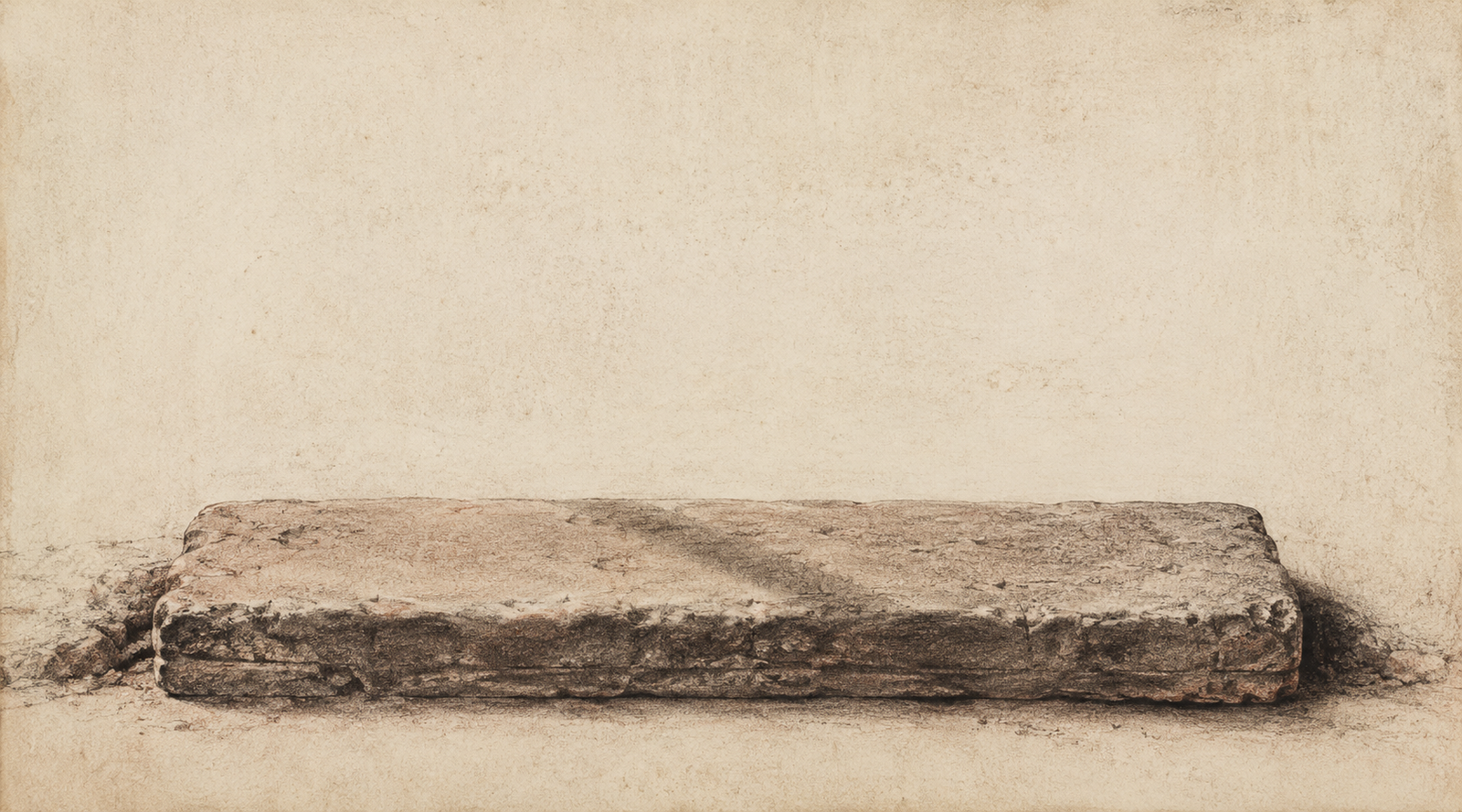

The Stone Is Not the World
A contemplative Angkor essay on surviving stone and the vanished human city around it.
There is a moment before Angkor Wat becomes knowledge.
It comes before the guidebook, before the name of the king, before the measurements, before the explanations history offers afterwards. It comes in the first half-light, when the towers are still less architecture than pressure against the sky, and the causeway holds the dark like a path not yet willing to speak. The eye does what the eye has always done at Angkor.
It rises.
It rises to the towers first. How could it not? They gather the morning before anything else has fully appeared. Their dark forms stand above the palm line with that grave, unhurried authority which surviving stone possesses. Then the eye begins to receive the rest: the long horizontal discipline of the galleries, the enclosure drawn across the earth, the balustrades, the lintels, the carved bodies of devatas waiting in their shallow chambers of shadow. Even before thought has arranged them, these things declare themselves. They have endured. They have crossed centuries to meet the morning.
And because they remain, they command belief.
This is not a failure of seeing. It is the beginning of seeing. No one stands before Angkor Wat at first light and thinks first of absence. The mind submits, naturally, to the grandeur that has survived. Stone has a moral weight in the imagination. It seems to have earned its authority by remaining when softer things have gone. It asks no permission from memory. It stands, and by standing it persuades.
The first mistake, then, is almost innocent.
It begins in reverence. It begins in the body’s obedience to scale, darkness, height, proportion, and silence. The towers rise; the eye follows. The causeway leads; the feet accept its invitation. The carved stone receives the first alteration of light, and the imagination, grateful for anything so durable, begins to let what remains define what was.
This is why Angkor is so easily mistaken for its temples.
Not because the temples are false. They are not false. They are among the great surviving articulations of human devotion, power, labour, and cosmological imagination. They are not decorative leftovers from a vanished world. They are that world concentrated with extraordinary force. To stand before them is to stand before something true.
But truth is not the same as entirety.
A tower can be true and still not be the world. A gallery can preserve the line of a civilisation’s sacred thought and still not preserve the lives that moved around it. A devata may keep, in stone, a face, a posture, an ornament, a hand resting in formal grace; but she cannot keep the smoke that rose beyond the enclosure, the wooden roofs that took the rain, the mats spread for trade, the food prepared before dawn, the roads under burden, the records written on leaf and lost to climate, the bodies that crossed, carried, waited, served, and disappeared.
At first light, none of this is visible.
That is the power of the monument. It does not merely stand in the landscape. It organises the imagination. It tells the eye where to go. It lifts attention upward, toward what was made to endure, and it does so with such splendour that the world below and around it can seem secondary, accidental, almost unnecessary. The temple becomes Angkor because the temple is what remains most absolutely.
Yet even here, before the towers have fully entered the day, another truth is present.
The causeway is not only an approach to stone. It is a surface for feet. The enclosure is not only a sacred boundary. It is a line between intensities of life. The threshold is not only an architectural joint. It is the place where bodies passed from one condition into another. The stone does not abolish the human world. It implies it.
One has only to look a little longer.
The morning does not remove the towers. It keeps them. But it begins, slowly, to loosen their solitude. The darkness thins around the lower stones. Edges appear underfoot. The vastness becomes touchable. A worn surface receives the first light before the highest tower brightens. Shadow lies across a step where countless feet once pressed their brief weight into a material chosen to outlast them.
What remains does not only survive.
It instructs.
Ruins do not speak evenly for the world that made them. They speak for what weather, fire, insects, water, war, devotion, neglect, repair, and chance have allowed to continue speaking. A civilisation does not choose, in any simple way, what the future will know of it. The future receives what matter permits.
At Angkor, matter has been severe.
Sandstone, laterite, brick, carved lintels, towers, galleries, enclosure walls, causeways, bas-reliefs, inscriptions: these have remained with a force almost impossible to resist. They have been broken, displaced, swallowed by roots, reassembled, worshipped, photographed, measured, cleaned, entered, misread, loved, restored, and worn again by feet. They have survived not untouched, but visibly enough to govern attention.
Around them, almost everything softer withdrew.
Wood darkened, split, burned, rotted, was eaten, reused, replaced, forgotten. Bamboo gave way. Thatch returned to soil. Cloth lost its colour and body. Palm leaves carrying words became dust or ash. Smoke rose and left no archive. Mats were spread and rolled. Baskets broke. Doors opened and vanished. Bodies crossed thresholds, grew old, died, were burned, scattered, remembered, and then passed beyond the keeping of stone.
The result is not only archaeological loss. It is imaginative distortion.
The mind is a practical creature. It builds its picture of the past from what it can still touch. If towers remain and houses do not, towers become more than towers. If inscriptions survive and palm-leaf records disappear, public declarations begin to outweigh ordinary accounts. If sacred stone stands while wood has gone, sanctity becomes easier to imagine than habitation. If the temple endures and the market does not, the temple begins to seem like the civilisation itself.
Endurance has its own bias.
It does not make the surviving thing false. It makes it powerful. It draws the eye toward what was already favoured: the sacred, the royal, the formal, the costly, the monumental, the official, the carefully cut. It gives greater authority to what could be made hard. It enlarges the places where wealth and devotion gathered strongly enough to insist on permanence.
But the roof that kept rain from a sleeping child did not keep itself for us. The smoke-blackened beam did not remain. The palm-leaf bundle tied and stored against damp did not cross the centuries with the same force as inscription. The hand that washed rice, the foot that crossed mud, the cloth folded for service, the ferry rope drawn through wet palms, the basket repaired because it was still useful — these belonged to the repeated things by which a world remains alive.
And so Angkor arrives before us with an uneven truth.
The temples are not false witnesses. They are among the most magnificent witnesses any civilisation has left. But they are not neutral witnesses. They are witnesses selected by material strength, sacred purpose, political force, conservation history, and the accidents of survival. They tell us what a society made durable. They do not, by themselves, tell us everything that made the society live.
This distinction matters because beauty can become a form of forgetting.
The more persuasive the surviving object, the more easily it occupies the whole field of thought. Angkor Wat does not ask to erase the wooden city around it. The Bayon does not ask to silence the markets, roads, ponds, kitchens, ferries, manuscripts, pavilions, granaries, and work-yards that once formed the wider human world. Yet surviving stone has a gravitational power. It pulls the imagination inward, toward itself. It makes the vanished seem secondary because the vanished cannot answer with equal force.
One must therefore be careful with awe.
Awe is not wrong. Without it, Angkor cannot be approached truthfully. But awe must learn humility before the absent. It must learn that the strongest survivor may not be the fullest witness. It must learn to ask what kind of world could have stood around this stone, served it, entered it, maintained it, feared it, loved it, crossed past it, lived under its shadow, and then disappeared almost completely from view.
The first correction is simple.
What remains is not the same as what was.
The stone is real. The stone is sacred. The stone is indispensable. But it is not proportionate. It has outlived the city’s softer body and therefore occupies more of our imagination than it occupied of life. To see Angkor only through stone is to accept survival as a map of truth.
It is not a map.
It is a remainder.
And this was not only an accident of material.
Angkor’s stone survived because stone endures. But it was also chosen because endurance mattered. It belonged, above all, to the realm of the permanent: to gods, sanctuaries, royal foundations, sacred mountains, enclosure, threshold, inscription, memory. It was the material in which devotion tried to outlast weather. It was the substance by which power made itself answerable to more than a human lifetime.
The living world was different.
Much of what people inhabited was built from materials nearer to the body and nearer to disappearance: wood, bamboo, thatch, palm leaf, woven fibre, cloth, rope, plaster, pigment, resin, paper, stored grain. These were not lesser because they were perishable. They were the materials of shelter, work, exchange, record, repair, and use. They belonged to the hand as much as to the eye. They could be cut, tied, carried, replaced, patched, smoked, eaten by insects, blackened by cooking, lifted by floodwater, lost to fire, remade by the next generation.
A house does not need to outlive a god.
This may be difficult for a modern imagination trained to equate survival with importance. We look for the permanent and call it central. But in Angkor, the very difference between what was made durable and what was allowed to perish tells us something profound about the order of the world. The temple was built to endure because it addressed what did not die. The dwelling accepted change because it belonged to those who did.
Even the king lived inside this tension.
His posthumous glory might require stone. His divine association might be secured through a sanctuary, a mountain-temple, a sacred image, a foundation meant to carry his name and merit beyond the limits of flesh. Yet the living king still moved through human structures: pavilions, halls, walkways, chambers, raised and roofed in wood, standing on bases or within enclosures whose harder remnants may remain after the splendour they supported has disappeared. The shell endures. The life within it is gone.
At Angkor Wat itself, this can be felt in something as simple as a doorway.
The stone frame remains. The wooden leaves that once made the opening close, darken, open again, and serve ritual movement are gone. Yet the surviving stone still keeps the shape of their absence. It does not merely frame emptiness. It shows that the hard material was made in relation to something softer, movable, handled, replaceable, and lost. The doorway is stone, but its meaning once required wood.
That is the argument in miniature.
The surviving stone gives us a partial hierarchy of intention. It shows us where permanence was desired most intensely: the divine dwelling, the sacred centre, the royal act of foundation, the line of praise, the carved body of a god, the threshold between human and more-than-human space. It shows us where labour, wealth, imagination, and ritual were concentrated into a form capable of resisting time.
But the same hierarchy also hides.
It leaves the visible world weighted toward what was made for gods and memory, while the human fabric that surrounded it — the raised house, the market shelter, the wooden door, the palm-leaf bundle, the cooking space, the mat, the cart, the granary, the tools laid aside at evening — withdrew into climate. The more ordinary a thing was, the more necessary it may have been to life, and the less likely it was to stand before us now.
This is why the vanished world must not be imagined as empty simply because it was not made of stone.
A wooden palace is not less real because termites finished what kings began. A palm-leaf record is not less administrative because humidity claimed it. A thatched roof is not less architectural because it returned to the ground. A basket, a rope, a mat, a painted ceiling, a double-leafed door, a scaffold, a beam, a post, a rice store, a ferry platform — these belonged to the working intelligence of the city no less than the gallery belonged to sacred display.
They have simply left another kind of trace.
Sometimes the stone itself remembers them. A window frame may preserve the logic of carpentry. A false door may carry, in stone, the gesture of a wooden one. A roof form may repeat an older habit of timber. A stone base may point to the pavilion that once rose above it. A socket may remember the vanished column. A tile may outlast the roof it covered. Even where wood has gone, its grammar can remain embedded in the harder material that replaced, framed, supported, or imitated it.
The stone, then, is not only stone.
It is also a survivor of choices made around other materials. It bears the pressure of what was meant to last and the shadow of what was not expected to. It preserves sanctity, but it also preserves absence. It tells us that the Angkorian world knew the difference between permanence and use, between divine duration and human repair, between what must stand for centuries and what could be remade because life itself would continue.
To see this is to let the monument become stranger and more humane at once.
The temple no longer appears as the natural body of the civilisation. It appears as its deliberate hardening: the place where the mortal world placed its strength in the service of what it believed exceeded mortality. Around that hardening was another intelligence, more flexible, more vulnerable, more intimate, and almost entirely gone.
Stone was chosen for permanence.
But Angkor was lived in the materials of change.
A temple, then, is not a census of a civilisation.
It is not built to preserve everything. It does not gather the whole range of living into stone. It does not contain, equally, every house, field, road, workshop, ferry, market, pond, kitchen, granary, sickbed, cradle, argument, repair, debt, song, and silence that made a world continue. It gathers differently. It gathers by intensity.
At Angkor, the temple was one of the places where life became most concentrated.
Power entered it. Devotion entered it. Wealth entered it. Labour entered it. Cosmology entered it. Royal ambition entered it. Agricultural surplus entered it. The hands of quarrymen, carvers, hauliers, priests, dancers, scribes, servants, cooks, guards, donors, and administrators entered it, not always visibly, not always named, but as the human pressure without which no sacred stone could have stood. A temple was not a mere object placed in a landscape. It was an institution, a destination, a treasury, a ritual engine, a statement of order, a house for divine presence, and a visible proof that a kingdom could gather enough force to make permanence.
This is why the temples must not be diminished.
To say that Angkor Wat is not the whole world is not to make it smaller. It is to make its truth more exact. The temple is not less astonishing because there were houses beyond it. It is more astonishing because those houses were there. It is not less sacred because roads, ponds, markets, and smoke surrounded it. It is more deeply sacred because sanctity had to be approached, served, fed, repaired, guarded, remembered, and returned to by people whose own dwellings could not hope to endure beside it.
The monument is not separate from the vanished world.
It is made by that world’s offerings. It is made by rice brought from fields, timber cut from forests, stone moved over distance, water managed through seasons, bodies organised into labour, gestures repeated until ritual became time’s own habit. It is made by devotion, but devotion does not float above matter. It requires oil, cloth, food, vessels, lamps, flowers, hands, paths, records, storage, command, obedience, fatigue, and return.
An offering carried to a sanctuary is not only a unit of supply. It is grain becoming devotion, oil becoming light, cloth becoming honour, labour becoming relation. The hand that carried it may vanish from the record, but the temple’s sanctity depended on such hands. A god could be housed in stone; the god still had to be approached by the perishable.
The temple concentrates all this.
But concentration is not totality.
A flame concentrates fire, but it is not the forest that fed it. A bowl concentrates water, but it is not the rain, pond, canal, river, hand, field, thirst, and carrying that brought water into human use. A temple concentrates Angkor’s sacred and political imagination, but it is not the city’s whole body. It is the place where certain energies become visible because they have been gathered into stone.
Around it, those same energies remained dispersed.
The field did not become temple, but the temple depended on field. The road did not become sanctuary, but the sanctuary required roads. The wooden house did not become immortal, but the immortal dwelling required the mortal one. The market did not become inscription, but the inscription presupposed a world where value moved, grain was measured, cloth was folded, animals were tended, obligations were recorded, and people knew where they stood in relation to god, king, household, season, and need.
A civilisation does not live only at its highest points.
It lives also in what supports height. It lives in preparation, maintenance, replenishment, habit. It lives in the repeated things that are too ordinary to become monuments and too necessary to be omitted from truth. Sweep the gallery once and the act disappears. Sweep it for years and the temple remains clean enough to receive god, king, pilgrim, monk, scholar, soldier, visitor, rain, bat, lichen, and dawn. Carry an offering once and the hand is forgotten. Carry offerings through generations and sanctity becomes an institution.
This is the human depth hidden inside splendour.
The carved stone shows the finished face of concentration. It shows the result after materials have been gathered, commanded, shaped, aligned, consecrated, and made hard. But the very existence of such concentration proves a larger field. Nothing so ordered stands alone. Nothing so costly appears without a world of extraction, transport, obligation, food, belief, skill, administration, fear, hope, and repetition beneath it.
To stand before Angkor Wat, then, is not to stand before a lie.
It is to stand before an intensity.
The mistake begins when intensity is mistaken for entirety. The temple becomes so persuasive, so beautifully sufficient in itself, that the imagination stops asking what had to exist beyond it. The eye receives the towers, the galleries, the enclosure, the devatas, and believes it has received Angkor. But what it has received is Angkor at one of its points of greatest condensation.
The world itself was wider, lower, softer, wetter, more perishable, more crowded, more repetitive, more human.
The temple gathered the visible power of that world.
It did not exhaust it.
What stone cannot hold is not marginal.
It cannot hold smoke. It cannot hold the smell of wet wood after rain, or the sourness of a pond edge, or the heat stored in a road by noon. It cannot hold the brief dark under a raised house, where tools, animals, baskets, rope, and shade may have gathered. It cannot hold the sound of a cart moving slowly over hard ground, or the small exhaustion of a body returning after labour, or the way a market disappears when the mats are rolled and the unsold things are carried away.
It cannot hold the ordinary because the ordinary is made to pass through use.
That is its dignity. A door is opened until it fails. A roof is repaired until the season defeats it. A post is replaced because rot has entered it. A mat is spread, worn, folded, and thrown away. A palm-leaf record is written because something must be remembered, then lost because the climate has no obligation to administration. A cooking fire burns, feeds, blackens, and leaves only a stain too fragile for centuries. A basket exists for carrying, not for history.
Yet these are the things by which a world is most continuously itself.
The temple could not have stood in isolation from them. Around the surviving stone were things that did not survive: wooden dwellings, pavilions, shelters, stalls, storehouses, vessels, cloth, food, tools, records, scaffolds, boats, fences, thatch, smoke. There were roads by which people came and went; ponds by which households were sustained; fields by which rice entered ritual, taxation, offering, hunger, and plenty; hands by which stone was cut, dragged, lifted, carved, washed, swept, garlanded, repaired, and entered into meaning.
There were also the innumerable acts too small to become monuments.
Someone had to clear a surface. Someone had to carry water. Someone had to prepare food. Someone had to fold cloth, tend flame, replace wood, mend rope, store grain, ferry bodies, move animals, count goods, sweep dust, keep account, wait at an entrance, open a door, close it, return the next day. Not all of this can be described securely. It should not be made into a false intimacy. But a great temple does not become a living institution without repetition, and repetition is almost always what history loses first.
Stone preserves event better than habit.
It can keep a consecration, a foundation, a royal name, a sacred body, a line of praise, a formal threshold. It can bear the posture of a devata, the body of a naga, the ordered ascent of a tower, the grammar of a cosmology made architectural. But it cannot keep the thousand preparations by which those formal things were made usable. It cannot preserve the tiredness after carrying, the hand rinsed after sticky rice, the voice calling across a road, the irritation of rain, the patience of maintenance, the fear of shortage, the small relief of shade.
It is not that these things were less real.
They were less durable.
The vanished world presses closest where the stone seems most complete. A gallery implies sweepers. A sanctuary implies attendants. A causeway implies feet. A moat implies crossing and maintenance, not only reflection. A threshold implies passage. An inscription implies other records that did not enter stone. A carved door may imply wooden doors. A stone base may imply a vanished superstructure. Even the most self-contained monument begins, under longer attention, to point beyond itself.
This is the work of re-seeing.
At first, the stone appears to gather the world into itself. Later, it begins to release the world back outward. The tower no longer stands alone; it draws around it the labour that raised it. The gallery no longer seems merely empty; it remembers bodies moving through shade. The causeway ceases to be only an axis of approach; it becomes burden, procession, heat, bare feet, animal traffic, return. The enclosure no longer marks only sacred separation; it begins to imply everything from which the sacred had to be separated, and everything by which it remained supplied.
The invisible city does not appear all at once.
It arrives as pressure. As implication. As a widening ring around the monument. First wood. Then water. Then smoke. Then roads. Then hands. Then storage, carrying, feeding, waiting, repairing. Then the uncounted, who do not step forward as characters but gather as necessary presence. The essay cannot give them faces it does not possess. It can only refuse to let the stone make them disappear twice.
This is why absence must be handled with care.
The lost world is not ours to decorate. It is not a stage on which to place invented lives so that the temples feel warmer. It is a discipline. One must learn to let the missing remain missing and still grant it weight. One must say: here the evidence stops, but the implication continues. Here the stone stands, but it could not have stood without those who are gone from it. Here the visible thing survives, and around it is the shape of what survival could not keep.
The city that made Angkor Wat possible was not an idea.
It was material, wet, tiring, fragrant, noisy, repetitive, hierarchical, devout, hungry, skilled, fragile, and alive. It had roofs that failed, paths that flooded, ponds that lowered, hands that cracked, fires that needed tending, tools that dulled, bodies that sickened, rituals that had to be performed again because yesterday’s offering did not feed today’s god. It was not less sacred because it was perishable. It was the perishable world through which sanctity had to pass.
Stone cannot hold all this.
But it can teach us where to look for it.
Not in the tower alone, though the tower remains. Not in the devata alone, though her carved face still gathers light. Not in the causeway alone, though it still leads the body forward. One must look beside the stone, below it, around it, through what it implies and what it excludes. One must ask what kind of world had to exist for this much permanence to be possible.
Then the monument changes.
It does not become smaller. It becomes inhabited by absence. Its splendour remains, but it is no longer solitary. Behind every hard edge, something softer has vanished. Behind every surviving surface, a world of use has gone quiet. Behind every stone that endured, there is the memory of materials that could not endure and of people whose lives were necessary to the stone’s own survival.
This is what stone cannot hold.
This is what stone hides.
To look again is not to look away from stone.
It is to return to it with a different obedience. The towers remain where they were. The galleries still hold their long discipline. The devatas still stand within their shallow weathered frames. The causeway still leads the body forward. Nothing has been diminished. Nothing has been exposed as false. The correction is quieter than that.
The stone is still the threshold.
But now it opens differently.
One begins to understand that the monument is not an end-point of seeing. It is an entrance into what can no longer be seen directly. The tower leads the eye upward, but it also asks what raised it. The gallery receives the body, but it also asks who kept such spaces alive before they became empty. The causeway carries the visitor, but it also remembers the countless crossings by which temple, field, house, road, water, service, and return once belonged to the same world.
This is the discipline Angkor asks of attention.
First awe. Then correction. Then a slower reverence.
Awe alone can leave the monument solitary. Correction alone can become dry, restless, too eager to prove that the visible thing is not enough. But reverence, if it deepens, does not choose between stone and world. It lets each restore the other. The stone gives the vanished city its surviving edge. The vanished city gives the stone back its human breadth.
Stand before Angkor Wat after this, and the old image remains. It must remain. The towers are still towers. Their ascent is still grave and astonishing. Their proportion still governs the morning. The long horizontal lines of the galleries still seem to steady the earth. The enclosure still holds its formal power. The whole monument still gathers the eye with an authority no argument should try to weaken.
But another Angkor has entered the picture.
The causeway is no longer only a ceremonial approach. It is feet, burden, procession, repair, heat, rainwater, animal movement, return. The moat is no longer only reflection. It is labour, edge, maintenance, crossing, stored season. The enclosure is no longer only sacred boundary. It is also proof that there was a world from which sanctity was set apart, and on which sanctity depended. The threshold is no longer merely stone. It is passage.
Even the silence changes.
Before, silence may have seemed to belong to ruin: the beautiful quiet left after a civilisation disappears. Now it is harder to accept that silence so simply. Much of what is silent was once ordinary noise. Wood underfoot. Water carried. Cloth shaken. Rice prepared. Tools struck. Carts drawn. Voices lowered near a sanctuary. Gongs, birds, insects, rain, flame, instruction, complaint, recitation, command. Not a spectacle of noise, not a scene invented for comfort, but the necessary sound of a world whose living materials did not cross the centuries with the same authority as stone.
The eye has learned to ask.
Not greedily. Not as if everything missing can be recovered. Not as if absence were merely a puzzle awaiting solution. It asks with restraint: what did this surface require? What kind of labour stood behind this splendour? What did this path connect? What vanished material does this surviving form imply? What did the stone preserve because it was chosen for permanence, and what did it fail to preserve because life itself was made of use, replacement, touch, climate, and return?
These questions do not weaken the temple.
They make it more truthful.
For Angkor Wat is not less magnificent when the wooden city returns around it in thought. It is more deeply placed. It no longer floats above history as an isolated sacred object. It stands again inside the human field that made it possible: fields and ponds, houses and roads, obligations and offerings, service and hierarchy, smoke and weather, repair and fatigue, devotion and administration, the counted and the uncounted. Stone remains the visible miracle, but the miracle now includes the world that could not remain visible.
This is the altered sight the essay has been moving toward.
The reader may still arrive before dawn. The towers may still rise first. They should. They are the great survivors. But after the first upward movement of the eye, another movement must begin. Attention must descend. It must come back to the causeway, the step, the threshold, the worn surface beneath the body. It must learn the humility of looking lower.
There, perhaps, the correction becomes simplest.
A stone threshold receives light. A shadow lies across it. The mark is small compared with the towers, almost nothing beside the scale of Angkor Wat. Yet it may teach the truer lesson. A threshold is not only architecture. It exists because something passes through. Its meaning is not in its endurance alone, but in passage, contact, repetition, feet, return.
The stone stayed.
The passing did not.
And still the stone carries the trace of having been passed over. Not the names. Not the full lives. Not the vanished roofs or the lost records or the smoke that rose and disappeared before any archive could keep it. But enough to correct the eye. Enough to say that no surviving surface is solitary. Enough to say that every hard thing at Angkor once stood within a softer world.
So one looks again.
At the towers, yes.
At the galleries, yes.
At the carved stone, the enclosure, the devatas, the moat, the long approach, the immense and beautiful authority of what has endured.
But also at the shadow beside them. At the ground around them. At what their survival has hidden. At the invisible city pressing, quietly and irreversibly, around the visible one.
The stone is real.
The stone is sacred.
The stone is not the world.
—
For paid subscribers, I have added a Workroom note on the making of this piece: how the essay nearly became an argument placed over Angkor, and how a doorway taught it how to see.
—
Receive the next work
Subscribe free to receive new work from the Lucas Varro Library by email.
More from the Library

See Also
A concise and impartial dictionary of absence, promises, quarrels, ordinary objects, and the troublesome instability of words.

The City of Service
The temple we inherit is a building from which almost all necessity has been removed. Nothing must be brought for it to continue being what we call a temple. The sanctuary asks nothing of us. Stone is good at this kind of independence.
A living temple was otherwise.
Water had to come in. So did grain, cloth, oil, aromatic substances, fuel. The things required for worship arrived because someone carried them across a threshold.

Houses of Wood, Light, and Smoke
Some of Angkor’s most intimate ruins do not rise above the ground at all. They are postholes, low mounds, hearths and ponds: durable traces of a domestic city built largely from things that decay. To restore that city is to see Angkor not only as stone, but as wood, smoke, water, repair, and people living within calling distance.