
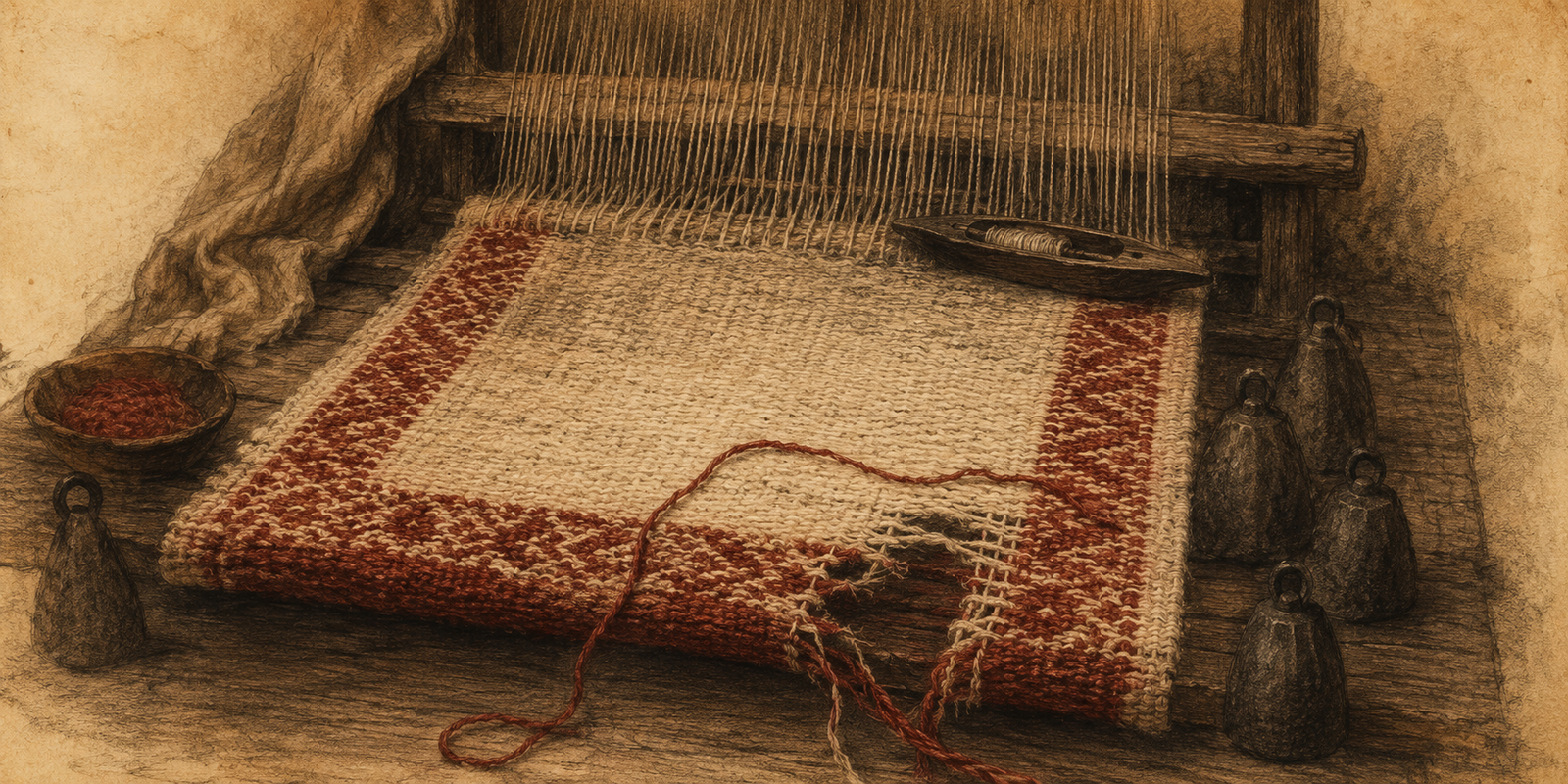

Arachne — The Weaver and the Goddess
Arachne — The Weaver and the Goddess is a House Tale from The Hospitable Dark: a retelling of the Arachne myth in a warm, grave voice, where mortal skill, divine power, pride, truth, and transformation gather around a loom.
Before Arachne became a warning, before the web became the remnant of a human life, there was a girl in Lydia who knew thread by touch. She had learned its tempers before she was old enough to be trusted with a full loom. Wool remembered the hillside. Flax remembered the field. Purple thread, born from crushed sea-creatures and sold to rich men for the colour of their importance, remembered the violence of its making.
Arachne’s father was a dyer. His house smelled of mordant, wet wool, river mud, smoke, and those sharp shells from which wealth bought splendour. He was not wealthy himself. That is one of the arrangements children notice before adults think to explain it: the man whose hands make purple may still eat from a plain wooden bowl.
But Arachne never minded plain things.
She liked the bench where the afternoon light lingered longest. She liked the clay jar where her mother kept the clean spindles. She liked the loom-weight in her palm, heavy and ordinary, as if some small part of the earth had agreed to help her keep order. She liked the moment before a pattern began, when the threads were stretched and waiting, and the whole cloth existed nowhere except in her mind.
By the time she was ten, people had begun saying only one thing.
“Look at her hands.”
Not her face. Not her manners. Not even her eyes, though they were bright and quick and missed very little.
Her hands.
They moved with a calm so complete it made older women stop speaking. They pinched, passed, lifted, beat, tightened, loosened, and smoothed as if they had been taught by something older than instruction. A pattern did not grow beneath them so much as emerge, like a thing long hidden under water.
At first, this made her mother proud.
Then careful.
Pride is a warm thing in a house when it sits beside the hearth and behaves itself. But when it grows tall enough to be seen from the road, neighbours begin to arrive carrying admiration in one hand and danger in the other.
Women came from nearby houses and stood near the door. Girls came pretending to borrow combs or ask about dye. Merchants came because merchants have an excellent nose for anything that may be praised into profit. Even old men who knew nothing about weaving except that women did it began making remarks with their hands clasped behind their backs.
“That child has been blessed,” one said.
“By Athena, surely,” said another.
At this, Arachne glanced up.
Only for a moment.
Then she returned to the cloth.
You must understand: Athena was not a small name in a weaving room. She was not a pretty story told to make work feel grander than it was. Athena was the clear-eyed goddess of the shuttle, the measured hand, the counted thread, the disciplined mind that turned wool into order. At the loom, whether a woman said the name aloud or not, she lived under Athena’s gaze.
So when people said Arachne had been blessed by Athena, they meant it kindly.
At first.
Kindness, however, is not always received in the form in which it is given.
Arachne did not think Athena had guided her hands. She knew the long days. She knew the sore wrists, the bitten lip, the ruined cloths cut apart in anger, the knots picked loose by lamplight after everyone else had slept. She knew the difference between a gift and labour, and she had never liked the habit people had of seeing only the flower and praising the weather.
Soon they said no girl in Lydia wove like Arachne.
Then no woman.
Then no mortal.
There are comparisons that should be stopped at the door.
This one was invited in and given wine.
Continue reading: Arachne — The Weaver and the Goddess at The Hospitable Dark on Substack.
Also in The Hospitable Dark

The Long Return VII — The Palace of Alcinous
Odysseus reaches the palace of Alcinous, but safety is not yet home. In this seventh instalment of The Long Return, hospitality becomes a moral test: a good house receives the stranger’s body before demanding his story.

When Favour Is Mistaken for Right — On Bellerophon
A companion essay to Bellerophon — The Bridle and the Fall, exploring Pegasus, divine favour, the bridle, heroic ascent, and the danger of mistaking help for permanent right. From The Hospitable Dark, this essay asks why Bellerophon’s tragedy is not false greatness exposed, but real help wrongly remembered.

Bellerophon — The Bridle and the Fall
A literary Greek myth retelling of Bellerophon, Pegasus, and the divine bridle: a tale of heroic ascent, misremembered grace, and the moment a true gift becomes proof in the wrong hands. From The Hospitable Dark, where old stories are retold in a warm, grave voice.
Continue Reading
If this piece found something in you, you may wish to continue the journey elsewhere.
On The Lantern Chronicles, I gather writings from Angkor, myth and legend, contemplative essays, and poetry — works shaped by silence, beauty, wonder, memory, and the deeper questions that follow us through the world.
It is a place for stone and story, reflection and vow, shadow and revelation.
You would be most welcome there.