
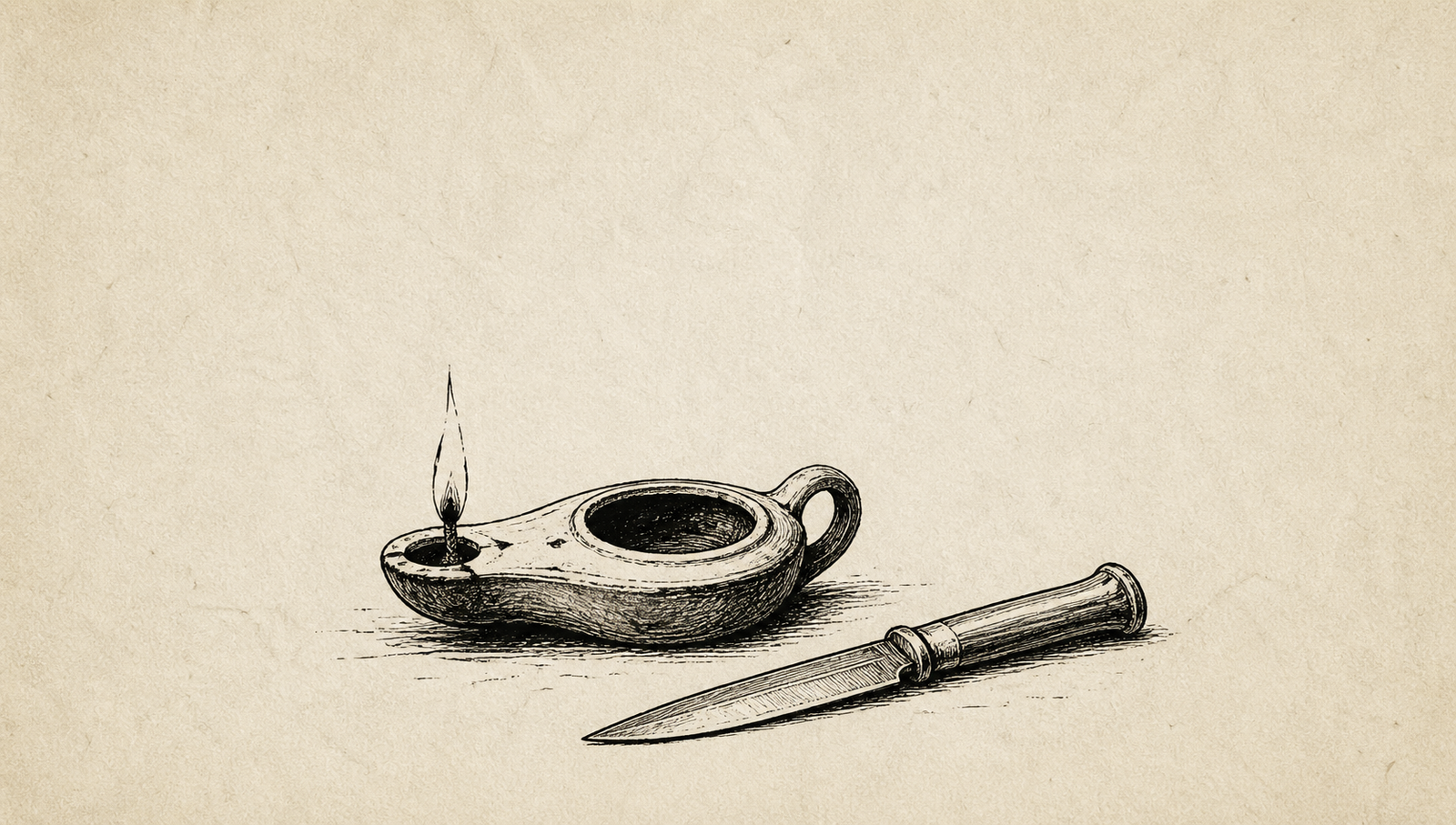

Eros and Psyche — The Lamp and the Wound
Eros and Psyche — The Lamp and the Wound is a literary myth retelling from The Hospitable Dark, returning the old tale of beauty, secrecy, fear, and love to its human beginning: a young woman worshipped for a face she never asked for, a hidden husband who demands trust in darkness, and the small lamp that makes the wound visible. The excerpt below opens the tale where its true pressure begins — not with romance, but with the loneliness of being looked at too much and known too little.
Beauty, when it belongs to another person, is very easy to call a gift.
It is less easy to carry when strangers begin to treat your face as though it were a public shrine.
Psyche learned this before she was old enough to understand why people lowered their voices when she entered a room. She was the youngest daughter of a king and queen, and in the beginning that should have meant only ordinary things: nursemaids, lessons, combs drawn through her hair, sandals beside the bed, her mother’s bracelets cool against her cheek when she was lifted and kissed.
But beauty, if it becomes famous enough, is no longer allowed to remain ordinary.
People came from neighbouring cities to look at her.
At first they came politely. They said they had business with the king, or offerings for the household gods, or a petition to lay before the queen. Then, when the pretence became too thin to hold, they simply came and stood in the courtyards, waiting for the youngest princess to pass from one room to another.
Some brought flowers.
Some brought fruit.
Some brought small carvings and lengths of dyed cloth and little clay lamps such as one might leave before a goddess.
This troubled the king. It troubled the queen more. It troubled Psyche most of all, though no one thought to ask her.
For when a girl is praised too much, people imagine she has been given something. They do not always see what has been taken from her.
Her two elder sisters were beautiful in the ordinary human way. They had suitors, quarrels, wedding chests, bridal songs being practised by servants who pretended not to gossip. They could be admired and still remain women. Psyche could not.
No young man came to ask for her hand.
No mother said, “My son would be fortunate.”
No father came with gifts and careful speech.
Men who would have married her sisters stood before Psyche as though marriage would be too bold a thought. They gazed at her and grew reverent. They spoke of her afterwards as though they had seen something beyond household life, beyond beds and bread and children.
So her sisters were married and carried away with torches and songs.
Psyche remained.
The rooms grew larger after they left. Their laughter no longer crossed the courtyard in the mornings. Their sandals no longer lay in careless pairs by the door. The loom room, where all three had once sat together, sounded too clean. Even the servants were gentle with her in a way that made her lonelier.
Meanwhile, beyond the palace, the goddess Aphrodite began to hear troubling things.
At first it was only a rumour.
A mortal girl, they said.
A face like dawn.
A beauty that made men forget the old shrines.
Aphrodite had endured praise for many centuries, which is not the same as being secure in it. Gods are not made calm by worship. Often they are made hungrier.
Her temples grew quieter.
Garlands that should have been laid on her altars were carried to the palace gates. Young brides whispered Psyche’s name before they whispered Aphrodite’s. Men who had once prayed to the goddess for desire now spoke of the princess as if the goddess had made a mistake and poured too much radiance into mortal clay.
Aphrodite heard all this.
She smiled.
It was not a kind smile, but it was not a simple one either. There was anger in it, certainly. There was vanity. There was the old immortal outrage of one who has never learned to be replaced. But there was also something colder and more wounded than jealousy. A goddess of beauty knows better than anyone how quickly worship turns upon the beautiful. She knew what it meant to be wanted by those who had never asked whether the beloved wished to be wanted.
That knowledge did not make her merciful.
Sometimes knowledge only sharpens the knife.
Continue reading: Eros and Psyche — The Lamp and the Wound at The Hospitable Dark on Substack.
Also in The Hospitable Dark

The Long Return VII — The Palace of Alcinous
Odysseus reaches the palace of Alcinous, but safety is not yet home. In this seventh instalment of The Long Return, hospitality becomes a moral test: a good house receives the stranger’s body before demanding his story.

When Favour Is Mistaken for Right — On Bellerophon
A companion essay to Bellerophon — The Bridle and the Fall, exploring Pegasus, divine favour, the bridle, heroic ascent, and the danger of mistaking help for permanent right. From The Hospitable Dark, this essay asks why Bellerophon’s tragedy is not false greatness exposed, but real help wrongly remembered.

Bellerophon — The Bridle and the Fall
A literary Greek myth retelling of Bellerophon, Pegasus, and the divine bridle: a tale of heroic ascent, misremembered grace, and the moment a true gift becomes proof in the wrong hands. From The Hospitable Dark, where old stories are retold in a warm, grave voice.
Continue Reading
If this piece found something in you, you may wish to continue the journey elsewhere.
On The Lantern Chronicles, I gather writings from Angkor, myth and legend, contemplative essays, and poetry — works shaped by silence, beauty, wonder, memory, and the deeper questions that follow us through the world.
It is a place for stone and story, reflection and vow, shadow and revelation.
You would be most welcome there.