
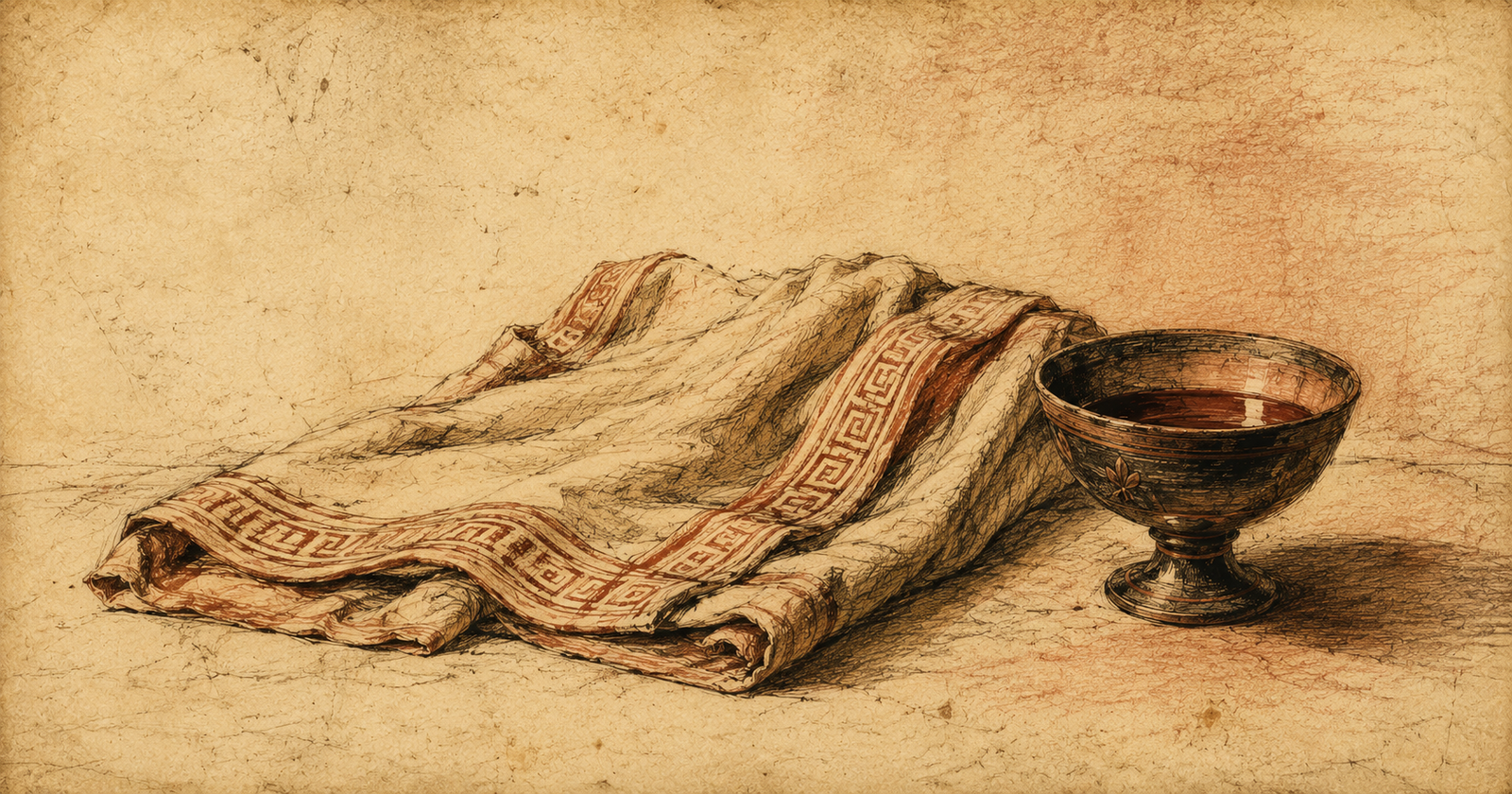

What War Leaves Behind in Beautiful Rooms
In this reader’s guide to The Long Return IV — Helen, Menelaus, and the Sea-God’s Word, the beautiful house of Sparta becomes one of the most unsettling rooms in Homer’s Odyssey. Telemachus does not arrive among ruins. He arrives among polished cups, folded garments, wedding preparations, careful hospitality, and people who have learned how to speak calmly around the wound of Troy.
This is not a guide to plot. It is a guide to atmosphere, memory, and war’s afterlife: how Menelaus and Helen remember Odysseus differently, how a son receives competing versions of his father, and how survival can arrange itself into beauty without becoming peace.
War does not always leave a house in ruins. Sometimes it leaves the cups polished, the garments folded, the marriages arranged, the servants moving quietly through rooms where everyone has learned what not to say. Sometimes the house survives so completely that a stranger might mistake its order for peace.
That is part of the unease of Sparta in The Odyssey.
When Telemachus arrives at the house of Menelaus, he does not enter a scene of visible devastation. He enters splendour. Menelaus has come home. Helen is there. Wealth has gathered around them from the long wandering after Troy. The household is active with wedding preparations, future alliances, proper hospitality, cups, horses, cloth, gifts, food, and all the formal signs by which a great house announces that it has endured.
But endurance is not innocence.
Ithaca, by contrast, is openly disordered. Its wound is easy to see. Men eat what is not theirs. The son is humiliated in his own hall. Penelope holds the house together by delay because no other form of authority has been left to her. Ithaca’s corruption has the bluntness of appetite. Sparta is different. Sparta has recovered its surfaces. That makes it harder to read.
The great subtlety of this episode is that Menelaus’s house is not false. Its hospitality is real. Its generosity to Telemachus matters. Menelaus is not pretending to have suffered; he knows exactly how much of his wealth came by grief. The house is not a lie. It is something more difficult: a place where grief has been made habitable.
That is one of the things war leaves behind. Not only widows, graves, broken ships, or the names of men who did not come home. It leaves rooms in which the returned must go on arranging life around what cannot be repaired. It leaves ceremonies that must continue because houses do not survive on sorrow alone. It leaves people who can speak of terrible things calmly because they have had years to learn where the words belong.
Menelaus is one form of that aftermath. He has returned with treasure, but the treasure has not simplified him. His memory of Troy is full of the dead. He remembers Odysseus with affection, but affection does not bring Odysseus nearer. He can tell Telemachus that his father was beloved, necessary, patient, brilliant, and still the boy leaves each sentence with less certainty than he had before. Praise, in this room, does not restore the father. It multiplies him.
Helen is the more dangerous form of the same aftermath.
Continue reading: What War Leaves Behind in Beautiful Rooms at The Hospitable Dark on Substack.
Also in The Hospitable Dark

The Long Return VII — The Palace of Alcinous
Odysseus reaches the palace of Alcinous, but safety is not yet home. In this seventh instalment of The Long Return, hospitality becomes a moral test: a good house receives the stranger’s body before demanding his story.

When Favour Is Mistaken for Right — On Bellerophon
A companion essay to Bellerophon — The Bridle and the Fall, exploring Pegasus, divine favour, the bridle, heroic ascent, and the danger of mistaking help for permanent right. From The Hospitable Dark, this essay asks why Bellerophon’s tragedy is not false greatness exposed, but real help wrongly remembered.

Bellerophon — The Bridle and the Fall
A literary Greek myth retelling of Bellerophon, Pegasus, and the divine bridle: a tale of heroic ascent, misremembered grace, and the moment a true gift becomes proof in the wrong hands. From The Hospitable Dark, where old stories are retold in a warm, grave voice.
Continue Reading
If this piece found something in you, you may wish to continue the journey elsewhere.
On The Lantern Chronicles, I gather writings from Angkor, myth and legend, contemplative essays, and poetry — works shaped by silence, beauty, wonder, memory, and the deeper questions that follow us through the world.
It is a place for stone and story, reflection and vow, shadow and revelation.
You would be most welcome there.