
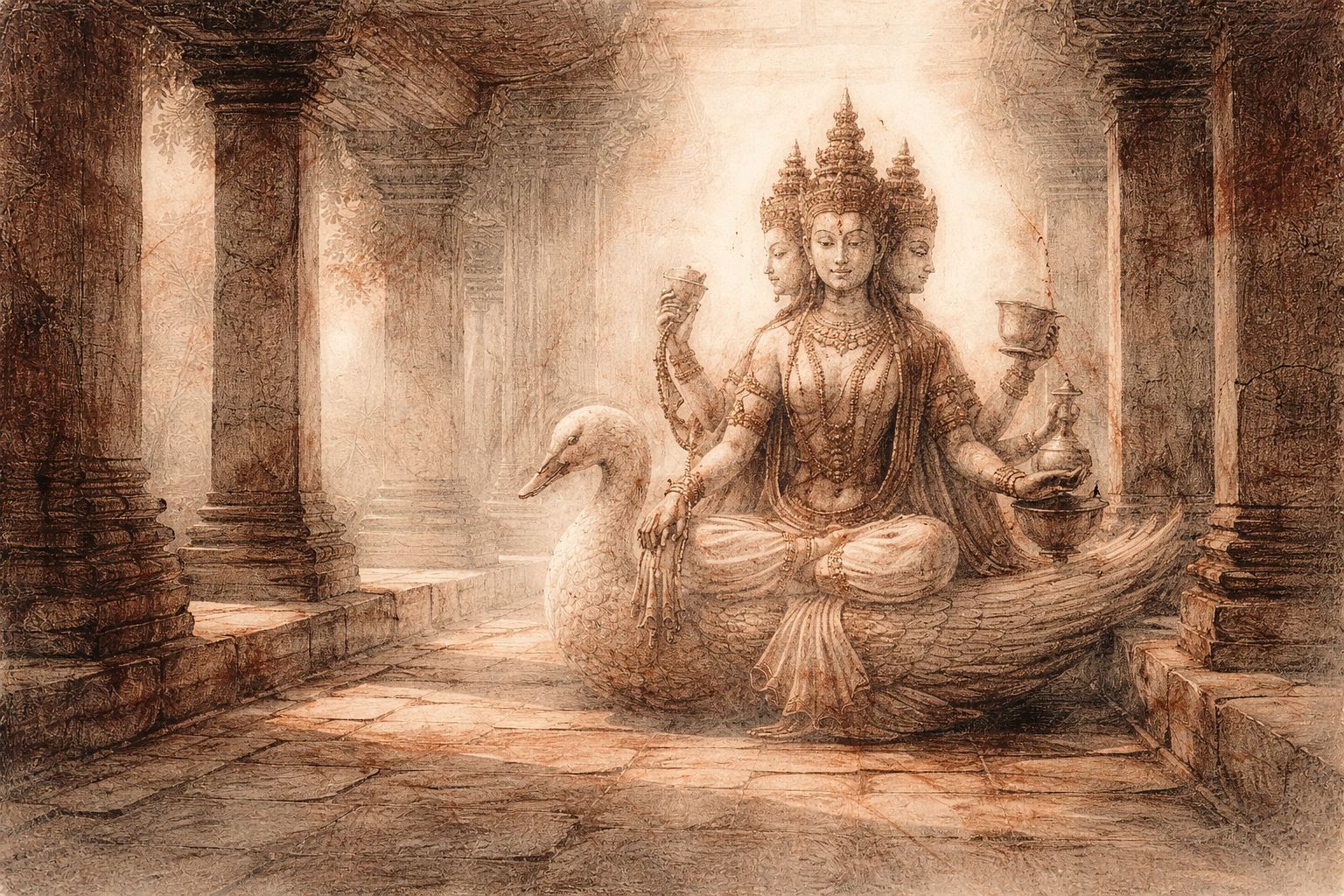

Brahmi at Angkor: The Energy That Sustains Form
There are figures at Angkor who do not announce themselves. They do not command the gaze or organise the space around them. They appear instead at the margins—on pediments glanced upward at too late, on towers weathered until detail softens into rhythm. Brahmi belongs to this quieter order. She is present where creation is no longer an event, but a condition already in motion.
She does not arrive as a narrative. There is no drama of origin carved around her, no moment of becoming. Her form is already complete, already at work. Multiple faces look without searching. Arms hold not weapons but measures: vessel, text, thread, bell. These are not instruments of conquest but of continuity. They suggest that what sustains the world does so through repetition, recall, and attentive balance.
In the temples, Brahmi appears not as an isolated goddess but as a function embodied. She stands for the energy that allows form to come into being and remain intelligible once it has arrived. Where Brahma is rarely seen in Khmer stone—his role too abstract, too withdrawn—Brahmi carries the burden of visibility. She is the act that follows intention, the movement that gives weight to design.
At Angkor, this distinction matters. The architecture is not speculative. It does not ask what might be. It commits to what must be maintained once the act of creation is complete. Towers stand because energy continues to flow through joints and proportions. Water is held because vessels were shaped to receive it. Brahmi’s presence echoes this ethic. She is creation understood as ongoing responsibility.
Her mount, the hamsa, appears less as a creature than as a principle. It is the bearer that moves between elements without strain. Earth and water, weight and buoyancy, are not opposed but reconciled through balance. In stone, this becomes a lesson in posture. The body learns to stand where forces meet without collapsing into excess.
The multiple heads attributed to her do not multiply identity; they distribute attention. They imply that creation does not proceed from a single gaze but from simultaneous awareness. Nothing is neglected. Nothing is rushed. This is not the ferocity of sudden birth, but the steadiness of sustaining care.
In certain Khmer contexts, Brahmi takes on a more severe aspect. Faces harden. The maternal becomes exacting. This severity is not cruelty but precision. Energy that creates without restraint destroys what it brings forth. The mother here is not indulgent; she is regulatory. She ensures that form does not exceed its capacity to endure.
Within the grouping of the Sapta Matrikas, this discipline becomes collective. Creation is not the task of one force alone, but of many energies acting in coordination. Each mother holds a domain, a charge, a boundary. Together they prevent the world from slipping into chaos or stagnation. Their power lies not in dominance, but in distributed guardianship.
At Angkor, this logic mirrors the organisation of the temples themselves. No single axis bears all meaning. Galleries, towers, basins, and thresholds share the labour of orientation. Movement is guided gradually. The pilgrim is shaped by accumulation rather than instruction. Brahmi’s presence within this system is less an icon than a reinforcement of its logic.
She reminds the visitor that creation is not finished simply because it exists. It must be held, renewed, corrected. The vessel must be refilled. The text reread. The bell sounded again, not to announce, but to mark continuity.
In this way, Brahmi does not stand apart from Brahmanic thought; she grounds it. Where the absolute remains beyond form, she accepts form as her responsibility. She ensures that what descends into matter does not forget its source. Creation is not a single act but a posture maintained across time.
To encounter Brahmi at Angkor is to sense that the world does not persist by accident. It is sustained by energies that do not seek recognition. They work at the level of structure, measure, and return. When the visitor leaves the temple, what lingers is not an image, but a recalibration: a renewed respect for what must be carried forward quietly if anything is to remain at all.
—
Receive the next work
Subscribe free to receive new work from the Lucas Varro Library by email.
More from the Library


See Also
A concise and impartial dictionary of absence, promises, quarrels, ordinary objects, and the troublesome instability of words.

The City of Service
The temple we inherit is a building from which almost all necessity has been removed. Nothing must be brought for it to continue being what we call a temple. The sanctuary asks nothing of us. Stone is good at this kind of independence.
A living temple was otherwise.
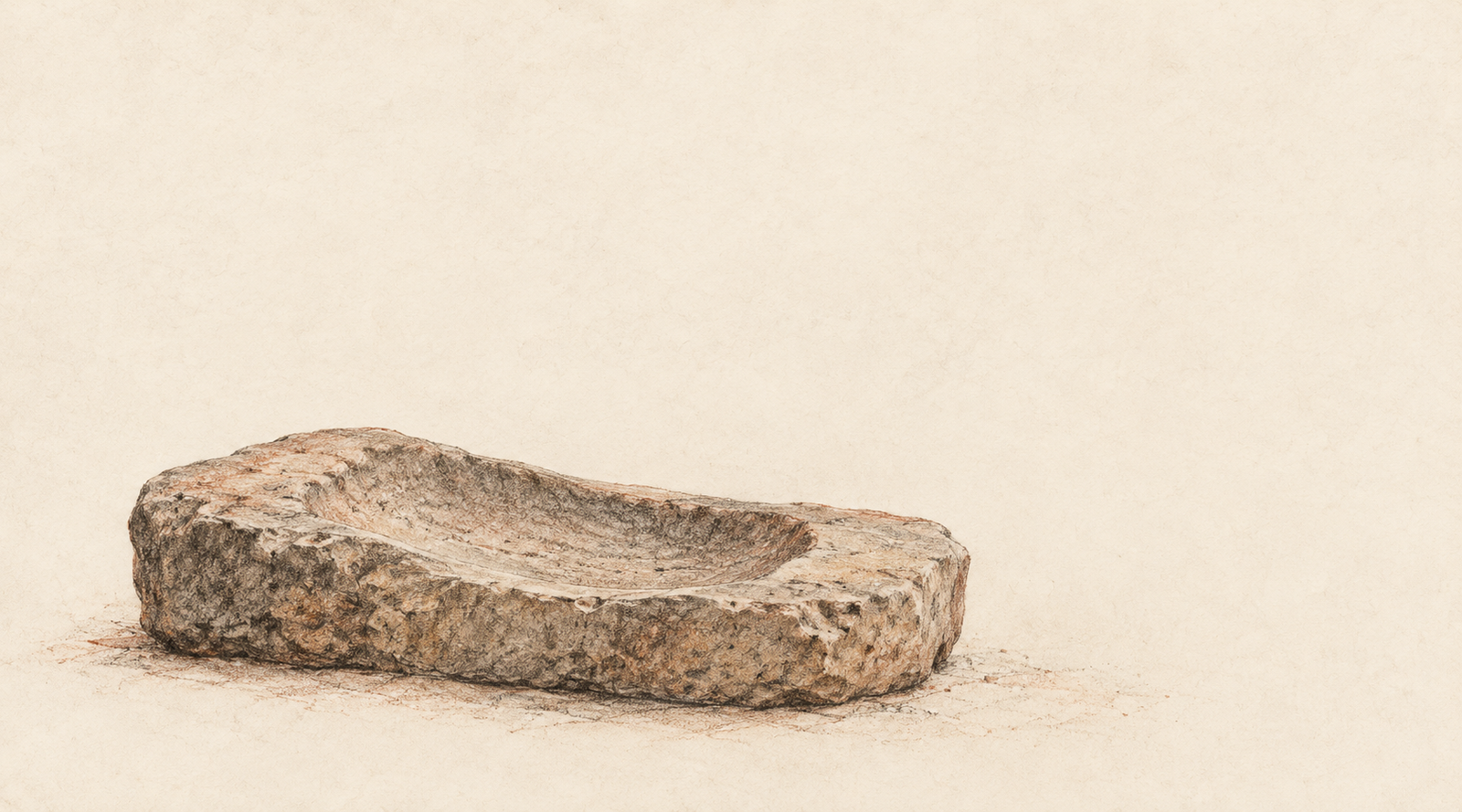
Water had to come in. So did grain, cloth, oil, aromatic substances, fuel. The things required for worship arrived because someone carried them across a threshold.


Houses of Wood, Light, and Smoke
Some of Angkor’s most intimate ruins do not rise above the ground at all. They are postholes, low mounds, hearths and ponds: durable traces of a domestic city built largely from things that decay. To restore that city is to see Angkor not only as stone, but as wood, smoke, water, repair, and people living within calling distance.