
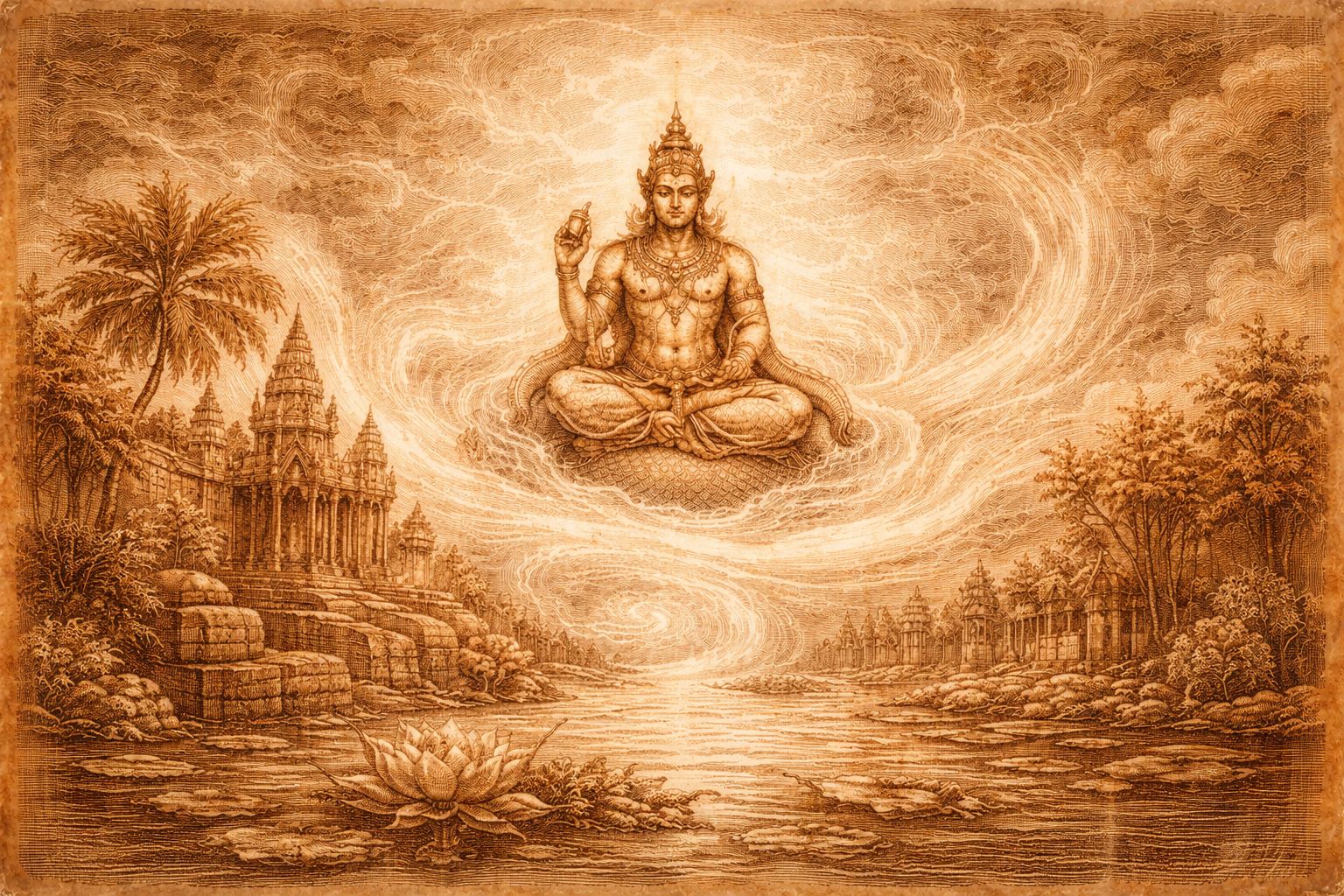

The Fifth Silence — Wind, Breath, Brahman
When fire has vanished,
when water has withdrawn,
when storm has spent its force,
and when judgement has been rendered,
something remains.
It does not shine.
It does not burn.
It does not flow or strike.
It does not judge.
It breathes.
In the Vedic imagination—and with particular clarity in Khmer cosmology—Wind is not merely one element among others. It is the condition that survives them all. Known as Vayu in its personal form, and as Brahman in its absolute aspect, wind is the highest holy power because it persists when all manifest forces have entered concealment.
Fire can be extinguished.
Water can be contained.
Storm can be exhausted.
Death itself can be completed.
Wind does not end.
It withdraws.
In the rite known as brahmanaḥ parimaraḥ—the “Dying round the Holy Power”—this truth is given its most precise expression. Lightning dissolves into rain. Rain ascends into the moon. The moon enters the sun. The sun, upon setting, is gathered and preserved within fire. And finally, fire itself breathes outward and upward, disappearing into the wind.
This is not destruction. It is invisibility.
Wind is the element that cannot be seen because it is the state in which seeing ceases. It is the final receptacle, the silent storehouse where all differentiated powers are received without resistance. When Indra, Varuna, Agni, and even Yama complete their offices, they do not vanish into nothing. They enter wind.
For this reason, wind is called Brahman—not as a god among gods, but as the undifferentiated ground of being itself. Brahman is not conscious in the human sense; it does not intend or judge. It sustains by remaining beyond grasp. Like wind, it is known only through effect: movement without form, presence without image.
The human self bears this mark. The word Ātman, the soul, arises from the root an—to breathe. At the deepest level, the self is not thought, memory, or identity. It is breath. What lives is what breathes. What dies is what releases breath back into the invisible.
Within the body, this cosmic wind is divided into the five prāṇas: the breath that enters, the breath that leaves, the fire that digests, the current that circulates, and the subtle ascent that rises toward the skull. These are not metaphors. They are the microcosmic reflection of the same order that governs suns and storms. The body is a small Angkor, held together by airflow.
When breath departs at death, it does not go “elsewhere.” It returns to what was always its source. Yama does not seize it. Agni does not burn it. Varuna does not drown it. Indra does not shatter it. Breath is simply no longer required to sustain a visible form.
And from this silence, the cycle begins again.
From wind, fire is kindled—by ritual, by friction, by intention. From fire, the sun is reborn. From the sun, the moon gathers measure. From the moon, rain descends. From rain, lightning flashes once more. Storm announces that concealment has ended.
This is why Angkor does not resolve in monumentality. It resolves in breath. The temples teach attention, pacing, restraint. They slow the body until breathing can be felt again. In doing so, they return the pilgrim—not to belief, but to alignment.
Wind is the element that receives all gods without rivalry.
Breath is the element that receives all lives without judgement.
When the last fire fades, when the last drop settles, when the last thunder falls silent, what remains is not absence—but the quiet certainty that everything has returned to where it was always held.
The fifth element does not speak.
It listens.
—
Receive the next work
Subscribe free to receive new work from the Lucas Varro Library by email.
More from the Library


See Also
A concise and impartial dictionary of absence, promises, quarrels, ordinary objects, and the troublesome instability of words.

The City of Service
The temple we inherit is a building from which almost all necessity has been removed. Nothing must be brought for it to continue being what we call a temple. The sanctuary asks nothing of us. Stone is good at this kind of independence.
A living temple was otherwise.
Water had to come in. So did grain, cloth, oil, aromatic substances, fuel. The things required for worship arrived because someone carried them across a threshold.

Houses of Wood, Light, and Smoke
Some of Angkor’s most intimate ruins do not rise above the ground at all. They are postholes, low mounds, hearths and ponds: durable traces of a domestic city built largely from things that decay. To restore that city is to see Angkor not only as stone, but as wood, smoke, water, repair, and people living within calling distance.