
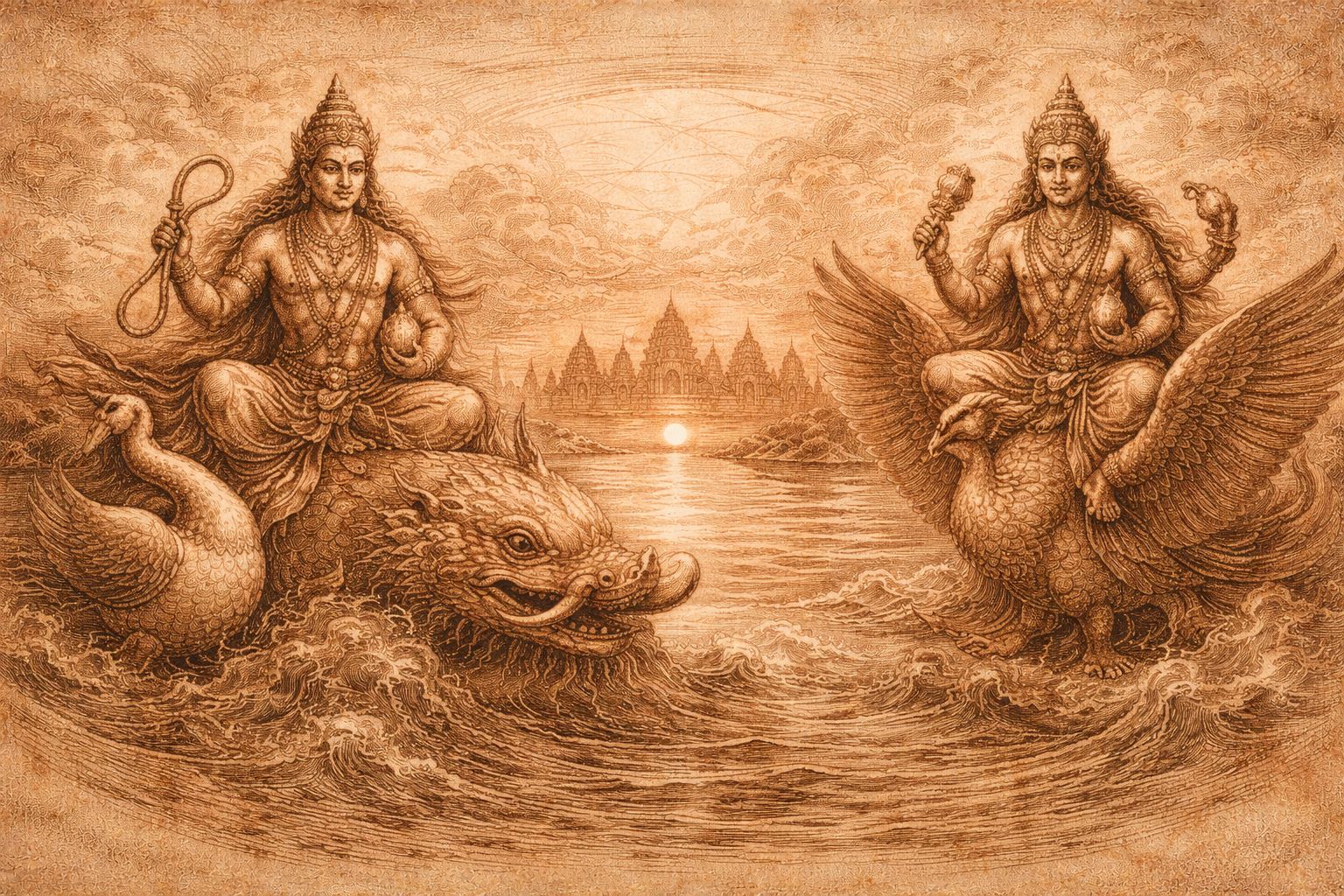

Varuna and Vishnu: The Western Guardians
The West is not where Angkor ends.
It is where things are completed.
In the earliest Vedic imagination, the West belonged to Varuna. Not as a place of decline, but as a domain of oversight—the quarter where the world must be accounted for before it disappears from view. Varuna ruled the wide sky before it darkened, the waters before they deepened, the moral law before it required enforcement. He did not govern beginnings. He governed consequences.
Varuna’s authority was never loud. He did not strike like Indra or blaze like Surya. He watched. The sun itself was said to be his eye. What passed beneath it could not escape record. To move westward was to move toward truth stripped of ornament, toward a horizon where intention and outcome meet.
Over time, this responsibility shifts. Vishnu assumes the western quarter—not by overthrow, but by inheritance. Preservation replaces judgement; continuity replaces restraint. Where Varuna bound falsehood with the noose, Vishnu stabilised the world by remaining within it. The West does not lose its gravity. It changes its task.
This transition mirrors a deeper cosmological rebalancing. Varuna belongs to an older order, where morality is enforced through cosmic law—ṛta—and deviation is dangerous. Vishnu belongs to a later vision, where the world is already fragile and must be held together through care, return, and measured intervention. The guardian remains; the method evolves.
Angkor absorbs this transformation without rupture.
In Khmer temples, Varuna appears first as guardian of waters and sky, riding the hamsa—creature of passage and discernment—then later as lord of rivers and oceans, seated upon the makara, embodiment of unseen depth. He becomes increasingly liminal: less sovereign, more custodial. His authority condenses rather than disappears.
Vishnu, meanwhile, rises not as conqueror of the West but as its fulfiller. His association with sunset, completion, and preservation finds its most exact architectural expression at Angkor Wat. The great temple does not face east into promise. It faces west into resolution. It is not oriented toward becoming, but toward being held in balance.
This is why Angkor Wat can function simultaneously as state temple, cosmic diagram, and funerary monument. The West, under Vishnu, is no longer a place of judgement alone. It becomes the place where the world is gathered, sustained, and allowed to endure beyond the life of its king.
Varuna does not vanish in this arrangement. He recedes into structure. Into water management, boundary-making, and the ethics of restraint. Vishnu does not replace him so much as stand where he once stood, carrying forward the same weight under a different name.
Seen this way, the western orientation of Angkor is not an anomaly. It is a continuity.
The Khmer did not abandon Varuna’s world for Vishnu’s. They translated it. Moral oversight becomes preservation. Binding becomes holding. The sky’s judgement becomes the temple’s endurance.
To walk westward in Angkor is therefore not to turn away from origins, but to move toward the place where all forces must be reconciled. Where water meets stone. Where time closes its circuit. Where guardianship is no longer enforced, but sustained.
The West remains what it always was:
the quarter where the world must still make sense.
—
Receive the next work
Subscribe free to receive new work from the Lucas Varro Library by email.
More from the Library


See Also
A concise and impartial dictionary of absence, promises, quarrels, ordinary objects, and the troublesome instability of words.

The City of Service
The temple we inherit is a building from which almost all necessity has been removed. Nothing must be brought for it to continue being what we call a temple. The sanctuary asks nothing of us. Stone is good at this kind of independence.
A living temple was otherwise.
Water had to come in. So did grain, cloth, oil, aromatic substances, fuel. The things required for worship arrived because someone carried them across a threshold.

Houses of Wood, Light, and Smoke
Some of Angkor’s most intimate ruins do not rise above the ground at all. They are postholes, low mounds, hearths and ponds: durable traces of a domestic city built largely from things that decay. To restore that city is to see Angkor not only as stone, but as wood, smoke, water, repair, and people living within calling distance.